The Wild Animal Sanctuary: What to Know Before You Drive to Keenesburg
Thirty miles northeast of Denver, past the last subdivision and out where the plains open up, there is a place where roughly 550 lions, tigers, bears and wolves live on 1,450 acres of Colorado grassland. You walk above them on an elevated bridge that runs more than a mile and a half. You will not stand next to a tiger. That is the entire point.
The Wild Animal Sanctuary in Keenesburg is not a zoo, and the difference matters more than most visitors expect. It changes what you see, how long you stay, what you should wear, and whether you leave satisfied or confused. This guide covers what the sanctuary actually is, what a visit costs and takes, and the handful of rules that turn people away at the gate.
Quick facts
| Where | 2999 County Road 53, Keenesburg, CO 80643 |
| From Denver | About 30 miles northeast, roughly 45 minutes |
| Hours | 9:00 a.m. to sunset, daily |
| Closed | New Year’s Day, Independence Day, Thanksgiving, Christmas, and during bad weather |
| Last entry | Two hours before closing |
| Admission | Adults 13 to 69, $50. Seniors 70+, $20. Children 3 to 12, $30. Under 3, free. |
| Tickets | Available online or at the gate. No advance purchase required. |
| Time needed | Three hours minimum. Most visitors stay four to six. |
| Walkway | More than 1.5 miles, elevated, fully wheelchair and stroller accessible |
| Dogs | Not allowed anywhere on the property, including in your car |
| Phone | 303-536-0118 |
Why the Wild Animal Sanctuary is not a zoo
A zoo is built so you can see the animals. A sanctuary is built so the animals can stop being seen.
Every animal at the Wild Animal Sanctuary arrived from somewhere bad: a roadside attraction, a basement, a bankrupt circus, a private owner who bought a tiger cub and learned what a tiger becomes. The sanctuary’s job is to give them large species-appropriate habitat, a proper diet, veterinary care and, as much as possible, the experience of being left alone.
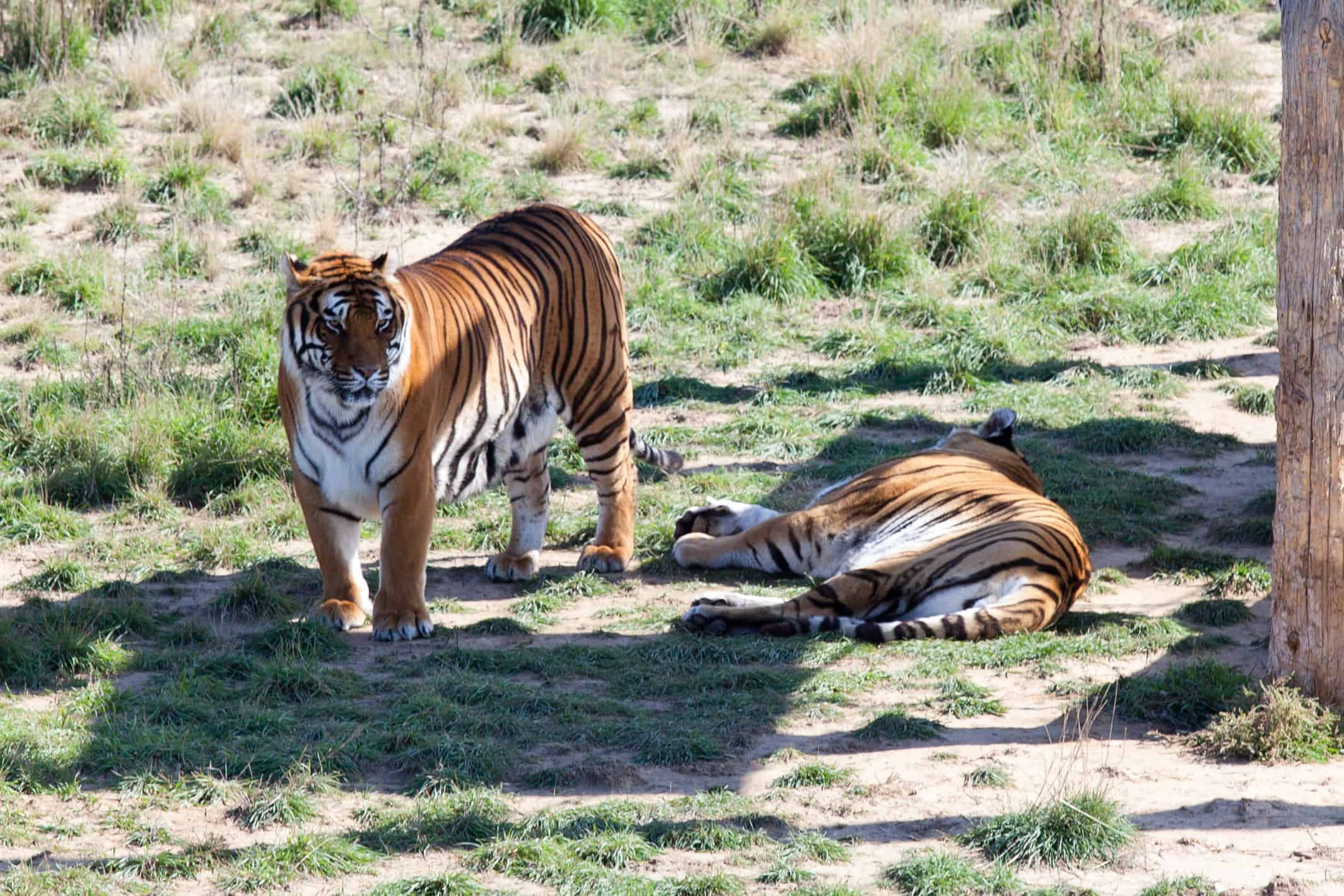
Which means the viewing is genuinely different. Animals are spread across hundreds of acres of rolling grassland. Some days a habitat looks empty because the bears are asleep in tall grass four hundred yards out. You are the one who adapts.
Set your expectations accordingly:
- You will not get close-up photos the way you would at a zoo. Bring a zoom lens or accept what you get.
- Some habitats will look empty. Keep walking. The next one usually is not.
- Nobody hands you a schedule of feeding times or shows. There are none.
- You cannot touch, feed or meet any animal. There is no behind-the-scenes encounter to buy.
If what you want is a guaranteed tiger at close range, the sanctuary says so itself, and the honest answer is that a zoo serves that better. If what you want is to watch a lion that spent years in a Bolivian circus cage do nothing in particular across eighty acres of open grass, this is the only place in Colorado that offers it.
The walkway
The sanctuary’s signature structure is an elevated pathway that the organization calls the Mile Into The Wild Walkway. It now runs more than a mile and a half over the habitats, and the sanctuary describes it as the world’s longest elevated footbridge.
The reasoning behind it is the most interesting thing on the property. Large carnivores read territory horizontally. They do not treat the air above them as contested space, so a person on a raised walkway does not register as an intruder the way a person at fence level does. The animals largely ignore you. You get to watch actual behavior instead of an animal watching you back.
The walkway connects three points: a 48,000-square-foot Welcome Center at the north end, the 15,000-square-foot Bolivian Lion House at the midpoint, and an education center with an enclosed rest area at the south end. Counting the side decks and viewing spurs, the sanctuary puts the total walking distance at about three miles.
Practical notes: the entire structure is ADA accessible, including for wheelchairs and strollers. It is also completely exposed. There is no shade, no windbreak, and Weld County weather does not negotiate. Sun protection in summer and real layers in winter are not optional.
Planning your Wild Animal Sanctuary visit
The rule that catches people out
Entry stops two hours before closing, and closing is sunset. In late December that means the gate may stop admitting visitors in the early afternoon. The sanctuary publishes a seasonal closing schedule and updates it, so check the current date before you drive out. This single rule is responsible for more wasted trips than anything else about the place.
No dogs, and they mean it
Dogs are not permitted on the property under any circumstances, including service dogs, and including dogs left in your vehicle. This is unusually strict and it is not negotiable at the gate. The sanctuary maintains a dedicated page about the policy. If you are road-tripping with a dog, this stop does not work.
What to bring
- Layers. You are on an exposed bridge on the eastern plains for several hours.
- Sun protection. Hat, sunscreen, sunglasses. There is no shade on the walkway.
- Water, though there is food on site.
- Binoculars or a zoom lens. This is the single best upgrade to the visit.
- Comfortable shoes. Three miles of walking is the realistic figure, not 1.5.
You can bring a picnic, and there is a café at the Welcome Center. Restrooms are available at the Welcome Center and at points along the route.
Budget more time than you think
The sanctuary’s own guidance ranges from “three to four hours minimum” to “most visitors stay four to six hours.” Treat four hours as the planning number. This is not a stop you slot between two other things.
When to go
Summer evenings are the best viewing of the year. The sanctuary runs a program it calls Wild Nights through the warm months and recommends arriving around 5:00 p.m. in July, August and sometimes September. The animals spend hot afternoons flat and asleep, then get up as the temperature drops. Wolves howl, lions roar, and the sun goes down over the Front Range behind them. It is a completely different experience from the same place at noon.
Winter is the underrated option. Cold-weather animals like wolves, tigers and bears are far more active in the cold than in the heat, and the crowds are thinner. The tradeoff is the early sunset and the two-hour entry cutoff, which compress the day hard. Go early.
Midsummer midday is the worst combination: hottest, most crowded, and the animals are doing the sensible thing and lying down.
If you are building a broader trip around the visit, our guide to the best time to visit Colorado covers how the seasons play out across the rest of the state.
The animals
The sanctuary says it cares for more than 950 animals across its three Colorado properties, with more than 550 of them at the Keenesburg site you can actually visit.
Approximate species counts at the sanctuary, from its own published list:
| Species | Approximate number |
|---|---|
| Black bears | 156 |
| Tigers | 85 |
| African lions | 70 |
| Alpacas | 51 |
| Grizzly bears | 43 |
| Wolves | 37 |
| Fox | 14 |
| Mountain lions | 12 |
| Coyotes | 12 |
| Bobcats | 9 |
| Lynx | 7 |
| Emus | 6 |
| Horses | 6 |
| Leopards | 5 |
| Camels | 5 |
| Coati-mundi | 4 |
| Caracals | 3 |
| Jaguars | 2 |
| Cheetahs | 2 |
| Ostriches | 2 |
| Raccoons | 1 |
The sanctuary attaches its own warning to that list, and it is worth repeating: animals arrive from new rescues and older animals pass on, so the numbers are a guide rather than a census. Do not drive out expecting to find a specific animal.
How a Boulder farm kid ended up running this
In 1980, Pat Craig was eighteen and visiting a zoo in North Carolina when he saw the back rooms: surplus big cats in cages, animals the zoo could not place and would not display. He went home to his family’s fifteen-acre farm outside Boulder and took in a jaguar. Then a mountain lion from Utah.
The organization outgrew Boulder and moved to Lyons, where it lasted eight years until a limestone quarry started blasting on the adjacent property. In 1994 it relocated to Keenesburg on an initial 160 acres, which has since grown to 1,450.
It opened to the public in 2001. The first observation platforms went up in 2002, and the named Mile Into The Wild Walkway opened in May 2012. The sanctuary has been accredited by the Global Federation of Animal Sanctuaries since 2019, and describes itself as the oldest and largest wild animal sanctuary in the world.
Today it reports roughly 170,000 visitors a year.
The rescues that built it
Bolivia, February 2011. The defining rescue. Bolivia banned animals in circuses in 2009, and eight circuses refused to comply. Working with Animal Defenders International, authorities confiscated the animals, and 25 African lions were flown from Bolivia to Denver in an operation ADI called Lion Ark. ADI credits the late Bob Barker, the longtime Price Is Right host and animal-welfare donor, with the substantial funding that made the operation possible before any public fundraising had been done. Barker died on September 1, 2023, at 99. The lions live on an 80-acre habitat, and the Bolivian Lion House at the midpoint of the walkway is named for them.
Ukraine, October 2022. Eleven lions were evacuated from the Biopark Zoo in Odessa as Russian forces advanced, driven 600 miles to Romania, and flown out. Two went to a reserve in South Africa. Nine came to Keenesburg.
Twenty-two moon bears, April 2022. A single airlift, completed after years of planning.
The “Tiger King” facilities. More than 147 tigers and other exotic animals from the Oklahoma, Indiana and Florida operations that the Netflix series made famous. Most of the animals people watched on television ended up here.
Puerto Rico. More than 400 animals from a hurricane-devastated zoo, the largest single rescue in the sanctuary’s history.
Pachuca, Mexico, November 2024. Eleven animals, including tigers and jaguars.
Across 46 years, the sanctuary says it has responded to more than 1,000 rescue requests, from Canada, Mexico, Panama, Bolivia, Argentina, Uruguay, Spain, Lebanon, Ukraine, Saipan and South Korea.
The two Wild Animal Sanctuary properties you cannot visit
This is the part almost nothing published about the sanctuary explains clearly, and it is the source of a lot of confused trip planning.
The Wild Animal Sanctuary operates three Colorado properties totaling more than 40,000 acres. Only one of them is open to the public.
Keenesburg, 1,450 acres. The one in this article. Open daily.
The Wild Animal Refuge, about 10,000 acres, near Springfield in southeastern Colorado. Acquired in 2018, it sits 35 miles west of town in Las Animas and Baca counties, with habitats running from 5 to 300 acres, including a 103-acre grizzly habitat and a 243-acre black bear habitat. It is not open to the public, and the sanctuary is blunt about why: the last 25 miles are narrow, rutted dirt county roads that become impassable in rain or snow, there is little cell service, and there are no emergency services. Access is limited to donors in two specific categories, on a handful of scheduled dates each year. Do not drive to Springfield expecting to see animals.
The Wild Horse Refuge, 30,000 acres, near Craig in northwestern Colorado. Acquired in early 2023 for wild mustangs removed in Bureau of Land Management roundups from the Sand Wash Basin and Piceance-East Douglas herd areas. It reports more than 230 mustangs. It operates its own website and its own visitation policy, separate from the Keenesburg sanctuary, so contact the refuge directly rather than assuming either way.
A fourth site, a 41-acre facility in Boyd, Texas, was taken over in 2018 and later closed once its animals were moved into the larger Colorado habitats.
Getting there and where to base
Keenesburg sits in southern Weld County, off I-76 between Denver and Fort Morgan. It is a genuine day trip from most of the northern Front Range.
From Denver: about 45 minutes via I-76. Easy round trip in a day.
From Greeley: about 25 minutes, the closest real city to the sanctuary. If you want to make a full day of it rather than driving back to Denver, Greeley has the food, lodging and museums to carry an afternoon, plus access to Pawnee National Grassland out east.
From Fort Collins: about 50 minutes. Fort Collins works well as a base if you are combining the sanctuary with the Poudre Canyon or a brewery day, and it gives you a much better dinner selection than anything closer to Keenesburg.
There is no lodging in Keenesburg itself worth planning around. Treat it as a destination you drive to, not a place you stay.
If the eastern plains are new to you, they reward the detour more than their reputation suggests. Our roundup of the most beautiful places in Colorado includes Paint Mines Interpretive Park, another plains destination that surprises people who only think of Colorado as mountains.
Is it worth $50?
For the right visitor, easily. For the wrong one, no, and it is better to know which you are before you drive out.
Go if you want to see large carnivores living in something approaching natural conditions, you are interested in the rescue story behind each habitat, you are comfortable walking three miles over several hours, and you do not need a guaranteed close-up.
Skip it if you are bringing a dog, you have ninety minutes, you need animals visible on demand, or you are traveling with someone who will not last on an exposed walkway in full sun or real cold.
The money is also doing something specific. The sanctuary is a 501(c)(3) that survives on admissions and donations, and feeding 156 black bears is not a rhetorical expense.
If you go
The Wild Animal Sanctuary 2999 County Road 53 Keenesburg, Colorado 80643 303-536-0118 wildanimalsanctuary.org
Hours: 9:00 a.m. to sunset daily, except New Year’s Day, Independence Day, Thanksgiving and Christmas, and during bad weather. Last entry is two hours before closing.
Admission: Adults 13 to 69, $50. Seniors 70 and over, $20. Children 3 to 12, $30. Children under 3, free.
Before you drive: check the current sunset closing time, check the weather page, and leave the dog at home.