
Breckenridge, Colorado: Five Peaks, a Victorian Gold Rush Main Street & Year-Round Adventure at 9,600 Feet

Breckenridge sits in a high mountain valley at 9,600 feet along the upper Blue River, flanked by the Tenmile Range to the west and the Continental Divide to the east. The five numbered peaks that form the ski resort — Peaks 6, 7, 8, 9, and 10 — rise directly behind the Victorian storefronts of Main Street, making breckenridge one of the few places in Colorado where you can walk from a 19th-century gold rush saloon to a gondola in about eight minutes. That juxtaposition of genuine history and world-class mountain infrastructure is what separates it from purpose-built ski resorts, and it’s what keeps people coming back in every season.
Summit County, Colorado is one of the highest-elevation counties in the United States, and Breckenridge is its most famous town. The base of the ski resort sits at 9,600 feet, with terrain climbing to 12,998 feet at the top of Peak 8 — high enough that altitude acclimatization is a genuine consideration for visitors arriving from sea level. The town’s permanent population hovers around 5,000 residents, but that number swells to tens of thousands during peak ski weekends in January and February, and again during summer festivals in July and August. In the shoulder seasons — late April through May, and October through Thanksgiving — you’ll find the same stunning scenery with dramatically smaller crowds and noticeably lower prices.
Visitors come to Breckenridge for skiing first, but they often discover that the summer version of the town rivals the winter one. The same trails that ski patrol grooms in December become world-class mountain bike routes by July. The wildflower meadows above treeline bloom from mid-July through August in colors that rival any display in the state. And the Main Street breweries, restaurants, and independent shops that fuel après-ski culture translate just as naturally into a warm-evening stroll in summer. Whatever season brings you here, plan for at least three nights — one is never enough.
| Elevation | 9,600 ft (town); 12,998 ft (Peak 8 summit) |
| Population | ~5,000 (permanent residents) |
| County | Summit County |
| Distance from Denver | ~80 miles west via I-70 and Hwy 9 (approx. 1.5–2 hours) |
| Nearest Airport | Denver International Airport (DEN) |
| Annual Snowfall | 300+ inches at the ski resort |
The History of Breckenridge
Breckenridge was founded in 1859 — the same frenzied summer that thousands of prospectors flooded Colorado’s high country following gold discoveries along the Front Range. The Blue River Valley offered rich placer deposits, and a mining camp grew almost overnight into a town substantial enough to warrant a post office by 1860. The original name honored John C. Breckinridge, then Vice President of the United States. When Breckinridge sided with the Confederacy at the outset of the Civil War, town residents demonstrated their Union loyalties with an inspired act of spite: they simply changed the spelling to “Breckenridge,” effectively disowning the man while keeping the name.
Gold mining defined the town through the 1880s. In 1887, a prospector named Tom Groves unearthed a single gold nugget weighing 13.5 pounds — still the largest placer gold nugget ever found in Colorado. The find, nicknamed “Tom’s Baby,” sparked renewed excitement and drew fresh waves of investment. By the 1890s, hard-rock silver mining had joined placer gold, and the town boasted a population of over 5,000, several newspapers, opera houses, and a surprisingly cosmopolitan cultural life for a remote mountain settlement. A collection of artifacts from this era is on display at the Breckenridge Welcome Center on North Main Street, and the entire historic downtown is listed on the National Register of Historic Places.
After the mining booms faded in the early 20th century, Breckenridge entered a long quiet period. The population dropped below 500 by the 1940s, and the Victorian buildings on Main Street fell into disrepair. The town’s second act began in 1961 when Breckenridge Ski Resort opened on Peak 8, initially served by a single Poma lift. Development was slow and deliberate — the ski resort expanded one peak at a time over the following decades, and the historic district was preserved rather than demolished, a decision that now gives the town its distinctive character. Peak 6, the newest terrain area, didn’t open until 2013, demonstrating that the resort is still growing a half-century after its founding.
Main Street & Neighborhoods
Breckenridge’s Main Street is genuinely walkable and genuinely historic — not a manufactured tourist district but a preserved Victorian streetscape where the bones of the buildings date to the 1880s and 1890s. The corridor stretches roughly from the Welcome Center at the north end to the base of Peak 9 at the south end, passing through about twelve blocks of shops, restaurants, galleries, and breweries. On a Saturday afternoon in January, the sidewalks are packed with ski boots and Gore-Tex. On a Tuesday in July, the same streets fill with cyclists, hikers, and festivalgoers in shorts.
The Arts District anchors the north end of town along Washington Avenue and the Blue River corridor. This is where you’ll find BreckCreate, the town’s arts organization, operating out of a cluster of repurposed historic buildings that include artist studios, a visual arts center, and the Breckenridge Arts District outdoor sculpture garden. The neighborhood has a noticeably quieter, more residential feel than the Main Street commercial strip — great for an early-morning walk before the shops open.
The ski resort’s base areas each have their own character. Peak 9 base connects most directly to town via a short walk or free gondola; this is where most first-time visitors enter the mountain. Peak 8 base sits about a mile west, served by the BreckConnect Gondola from the edge of Main Street — this route passes through the historic Gold Run neighborhood, where several of the town’s best restaurants and a handful of Victorian bed-and-breakfasts occupy side streets. The newer Peak 7 and Peak 6 developments offer ski-in/ski-out condominiums with their own commercial clusters of cafes and equipment shops.
Outdoor Recreation in Breckenridge
The mountains surrounding Breckenridge offer four-season recreation that would fill multiple trips. Winter skiing is the obvious draw, but summer hiking, mountain biking, fishing, and paddleboarding on nearby reservoirs give the town a legitimate claim as a year-round destination. The key is that nearly all of this activity concentrates within a short drive or bike ride of downtown.
Skiing at Breckenridge Ski Resort
Breckenridge Ski Resort spans five interconnected peaks and 3,398 vertical feet — the largest vertical drop of any ski resort in Summit County. The resort’s 187 trails cover terrain for every ability level, from the gentle beginner slopes on Peak 8’s upper lifts to the double-black-diamond chutes in the Imperial Bowl above 12,000 feet. The Imperial Express SuperChair serves the highest lift-accessed terrain in North America, topping out at 12,840 feet. Annual snowfall averages over 300 inches, and the resort sits at high enough elevation that snow quality stays excellent through March and into April.
For beginners and intermediates, the Peak 8 magic carpet and dedicated learning area are among the best in Colorado. For advanced skiers and snowboarders, the combination of North Bowl, Lake Chutes, and the Peak 6 Back Bowls offers challenging terrain that rivals anything at Vail or Aspen. The resort connects to Keystone via the Summit ski shuttle during ski season, and Epic Pass holders can access both mountains on the same pass. Weekend lift lines at Peak 9 base can stretch 30 minutes on holiday weeks — arrive early or buy a Peaks Pass reservation.
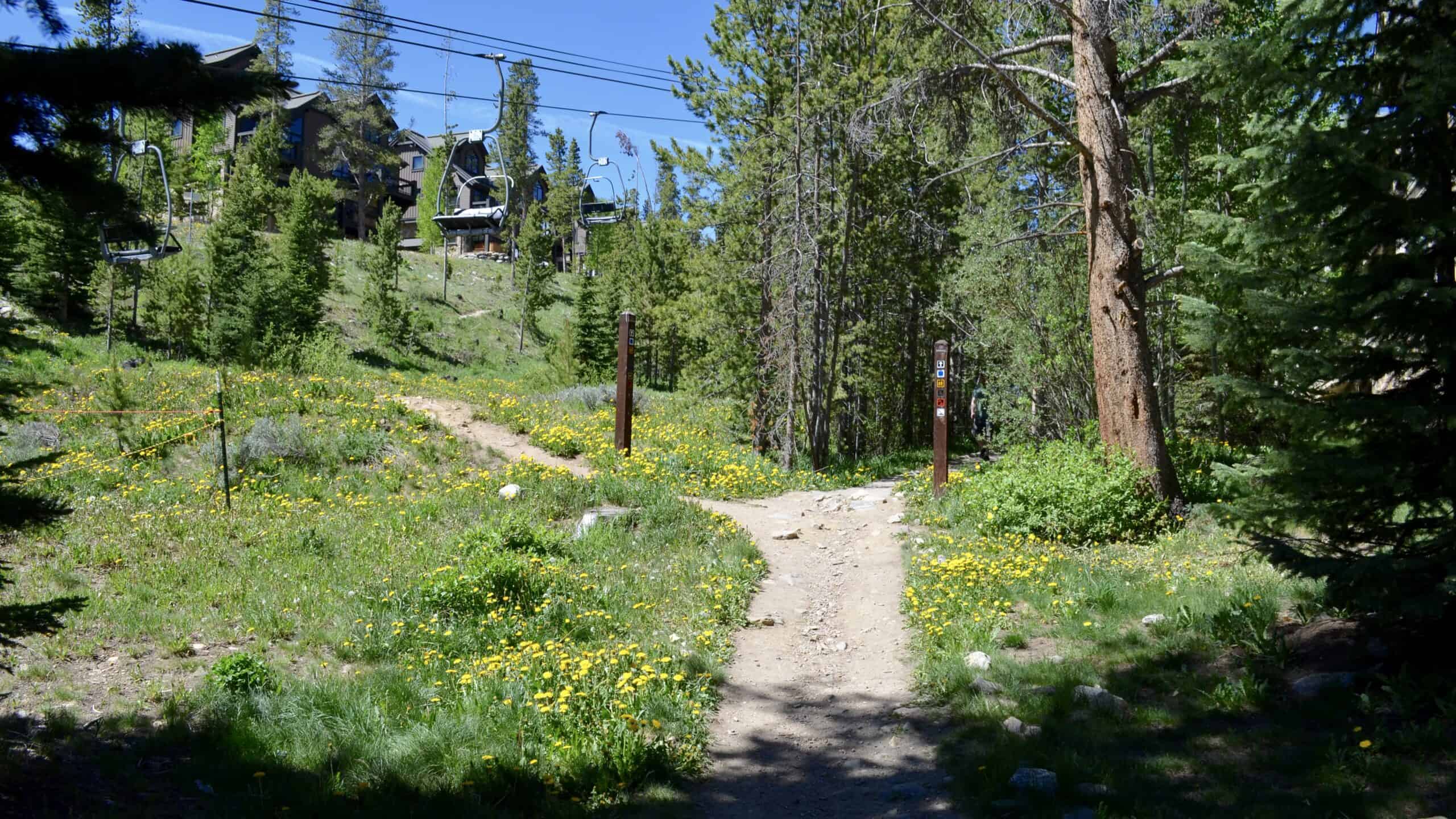
Hiking Trails Near Breckenridge
The trail network around Breckenridge is extensive enough that you could spend a full week hiking without repeating a route. Quandary Peak, located about 7 miles south of town via Highway 9 and County Road 850, is one of Colorado’s most accessible 14ers — the standard East Ridge Route gains about 3,300 feet over 3.4 miles each way, reaching the 14,265-foot summit in three to five hours round-trip for fit hikers. The trail is well-marked but exposed above treeline, making an early start (trailhead by 6 a.m.) essential to beat afternoon thunderstorms.
For something less strenuous, the Sawmill Trail network on the lower slopes of Peak 10 offers a system of interconnected singletrack paths through aspen groves and meadows. The Peaks Trail connects Breckenridge to Frisco over 8.5 miles of high-alpine terrain, crossing treeline at the midpoint for panoramic views of the Tenmile Range. Crystal Lakes Trail, accessed from just south of town off Spruce Creek Road, climbs 4.5 miles to a cluster of high-alpine lakes above 12,000 feet, with stunning views of the Continental Divide. The Moonstone Trail and Bakers Tank Trail offer shorter family-friendly options within walking distance of town that show off the aspen and spruce forest without requiring significant elevation gain.
Mountain Biking
When the lifts stop spinning in spring, Breckenridge Ski Resort opens its terrain to mountain bikers. The Epic Discovery bike park on Peaks 7 and 8 runs lift-accessed downhill trails from late May through early October, with rental bikes and lessons available at the base. The dedicated flow trails and jump lines draw riders from across the Front Range on summer weekends. For riders who prefer climbing under their own power, the Colorado Trail runs through the Breckenridge area in several segments — the stretch from the Goldhill Trailhead south toward Copper Mountain follows ridgeline terrain above 11,000 feet with views that make the climbing worthwhile. Boreas Pass Road, a 23-mile gravel route over the Continental Divide to Como, is one of the classic bike tours in Summit County, following the route of the old Boreas Pass Railroad with gentle grades and wildflower meadows at the summit.
Fishing & Water Sports
The Blue River through Breckenridge is designated a gold medal trout fishery below Goose Pasture Tarn — a roughly two-mile stretch of the river that produces trophy-sized rainbow and brown trout on dry flies throughout the summer. Tenmile Creek, which joins the Blue River at Frisco, offers additional quality water that’s less pressured than the main stem. For stillwater fishing, the Dillon Reservoir at Frisco offers good rainbow and brown trout fishing from boat or shore, and the reservoir’s recreation area has launch facilities for kayaks and paddleboards. Stand-up paddleboarding on Dillon Reservoir has become one of Summit County’s most popular summer activities — rentals are available at the Frisco Bay Marina.
The Breckenridge Troll & Public Art Scene
In 2018, Danish artist Thomas Dambo installed a 15-foot wooden troll sculpture named Isak Heartstone in a forest clearing near the Cucumber Gulch Wildlife Preserve, just below the Peak 9 base area. The troll — a friendly, humanoid figure built entirely from reclaimed timber — was intended as a temporary installation but became so beloved that the town made it permanent. Isak Heartstone is now one of the most photographed spots in Colorado, drawing visitors who might not otherwise think of themselves as “art people” into a forest walk they’ll remember for years. The half-mile trail to the troll is accessible year-round and connects to the Cucumber Gulch trail network.
The Breckenridge Creative Arts organization — known locally as BreckCreate — has transformed the town’s Arts District into a genuine creative hub. The BreckCreate campus on Washington Avenue includes open artist studios, a ceramic arts center, a printmaking studio, and a rotating gallery program that shows work by both emerging and established artists. The annual Breckenridge International Festival of Arts (BIFA), held every August, brings large-scale public art installations, performance pieces, and interactive installations to outdoor locations around town for two weeks. BIFA programming is largely free and accessible to all ages, and it’s become one of the summer’s most anticipated events for locals and visitors alike. The Breckenridge Music Festival, also running in summer, presents orchestral concerts and chamber music in the Riverwalk Center amphitheater.
Public sculpture is woven throughout the town and ski resort beyond the troll. The Sculpture on the Blue program places rotating works in parks and along the river corridor. The ski resort’s Peak 8 base features large-scale bronze works. And the historic district on Main Street includes interpretive markers and occasional temporary installations as part of the town’s ongoing commitment to integrating art into everyday public spaces.
Food & Drink in Breckenridge
The dining scene in Breckenridge punches well above its small-town weight class, reflecting decades of development as a resort destination that attracts visitors with high expectations. Main Street and its surrounding blocks hold everything from quick-service breakfast spots to fine-dining rooms with serious wine lists. The brewpub scene is particularly strong — Summit County has one of the highest concentrations of craft breweries per capita in Colorado.
Broken Compass Brewing, on South Main Street, is the town’s defining brewery — a community gathering space that has won national awards for its rotating tap list, which runs from sessionable pilsners to barrel-aged imperial stouts. The taproom has a lively, unpretentious atmosphere and fills quickly after last lift. The Hearthstone Restaurant occupies a restored Victorian house on Ridge Street and is widely considered the best fine-dining option in town — the elk and bison preparations are reliably excellent, and the wine cellar is one of the more impressive in Summit County. For steakhouse dining, Kenosha Steakhouse on Main Street has been a local institution for decades, anchoring its menu around prime rib and hand-cut Colorado beef.
Briar Rose Chophouse & Saloon occupies a historic building that feels genuinely western — antler chandeliers, hardwood floors, and a straightforward menu of properly cooked steaks and Colorado lamb. For something more casual, Downstairs at Eric’s is the après-ski institution: a basement sports bar and bowling alley with over 50 beer taps and a menu designed to absorb whatever you burned on the mountain. Amazing Siam, tucked off the main drag, consistently ranks among the most reliable Thai restaurants in the mountain towns. The Whale’s Tail on the Blue River serves breakfast until 2 p.m. — the corned beef hash and the biscuits-and-gravy are Summit County standards, and the riverside patio is genuinely lovely in summer.
Breckenridge Distillery, just north of town on Airport Road, produces several well-regarded whiskeys and offers a distillery tour and tasting room. The flagship bourbon has won major spirits competitions, and the tasting experience is a worthwhile detour on a non-ski day or during a shoulder season visit.
Where to Stay in Breckenridge
Breckenridge has more lodging variety than most Colorado ski towns its size, ranging from budget-conscious hostel beds to five-star ski-in/ski-out condominiums. The right choice depends heavily on what you’re after — proximity to lifts, access to town, price point, and the amenities you consider non-negotiable.
For true ski-in/ski-out access, Crystal Peak Lodge at the base of Peak 7 offers one, two, and three-bedroom condominiums with high-end finishes, an outdoor heated pool, hot tubs, and a full aquatics center. One Ski Hill Place at Peak 8 base is the most luxurious option in the resort — the one and two-bedroom suites are spacious, the on-site bowling alley and media rooms are popular with families, and the ski access is as direct as it gets. The Village Hotel sits at the base of Peak 9, which offers the most direct in-town access — you can walk to Main Street restaurants in five minutes while still clicking in for first chair.
For mid-range visitors who prefer walkability over slope proximity, the properties along Main Street and Ridge Street offer the best access to restaurants, shops, and the free town shuttle system. The Lodge & Spa at Breckenridge sits on a hillside above town with panoramic views and a full-service spa — it’s slightly removed from the ski resort base but well-suited to visitors whose trip is as much about the town as the mountain. Gravity Haus Breckenridge, formerly the Breckenridge Inn, has been renovated into a wellness-focused property with a fitness center, hot tubs, and a community ethos that appeals to the younger outdoor-adventure crowd. At the budget end, Bivvi Hostel offers clean, well-designed bunk rooms and private rooms in a social setting that’s popular with solo travelers and groups looking to minimize accommodation costs in an otherwise expensive town.
Vacation rental condominiums and private homes represent a large share of the Breckenridge lodging supply. For groups of four or more, renting a multi-bedroom condo often works out cheaper per person than comparable hotel rooms, and gives you a kitchen for breakfasts and après-ski snacking. The Blue River corridor, Shock Hill neighborhood, and the terrain near Peak 7 are popular areas for vacation rentals with good access and quieter surroundings.
Day Trips from Breckenridge
Breckenridge’s position in the heart of Summit County puts it within easy reach of some of Colorado’s best destinations. Most of the following day trips involve simple drives on clear, well-maintained roads — though mountain passes can close briefly during major winter storms.
Keystone (6 miles east)
Keystone Ski Resort sits just 6 miles east of Breckenridge via Highway 6 through the Blue River Valley, making it an effortless half-day add-on for skiers and snowboarders. Keystone’s night skiing operation — the most extensive in Colorado — runs Sunday through Thursday until 8 p.m., which pairs perfectly with a full day at Breckenridge followed by an evening run or two at Keystone. In summer, Keystone’s Adventure Point on the mountain offers a climbing wall, mini-golf, ziplines, and the Kidtopia festival activities for families. The village has good dining options and a small collection of shops.
Frisco & Dillon Reservoir (9 miles north)
Frisco is Summit County’s underrated gem — a walkable small town with a strong Main Street dining scene, excellent access to the Dillon Reservoir recreation area, and significantly lower accommodation prices than Breckenridge. The Dillon Reservoir, a 3,300-acre reservoir surrounded by mountain peaks, offers paddleboarding, kayaking, sailing, and one of Colorado’s most scenic bike paths — the 23-mile Summit County Recreation Path circumnavigates the reservoir and connects Frisco, Dillon, Silverthorne, and Keystone. The Frisco Historic Park preserves several original buildings from the town’s railroad and mining era.
Copper Mountain (22 miles west)
Copper Mountain Ski Resort sits 22 miles west of Breckenridge on I-70, passing through the Eisenhower/Johnson Tunnel under the Continental Divide. Copper is known among serious skiers for its naturally delineated terrain — beginner slopes on the east side, intermediates in the center, expert terrain on the west — which reduces run-in encounters between ability levels. The resort hosts several major freeskiing and snowboarding events each winter. In summer, the resort’s Union Creek area becomes one of Summit County’s best mountain bike trail networks, with dedicated pump tracks, flow trails, and technical singletrack accessible by lift.
Vail (27 miles west)
Vail is just 27 miles from Breckenridge via I-70, making it an easy day trip for skiers who want to experience the massive Back Bowls and Blue Sky Basin. Vail’s ski terrain dwarfs Breckenridge in total acreage, though the two resorts are comparable in vertical drop. The Vail Village and Lionshead pedestrian areas offer upscale dining and shopping worth exploring even outside ski season. The Gerald R. Ford Amphitheater in Vail hosts concerts and events throughout summer. Epic Pass holders can access both resorts on the same credential, which takes some of the financial friction out of day-tripping between them.
Quandary Peak (7 miles south)
Quandary Peak, one of Colorado’s 58 fourteeners at 14,265 feet, sits just 7 miles south of Breckenridge and is routinely ranked as one of the most approachable 14ers in the state. The standard East Ridge Route is 6.75 miles round-trip with 3,450 feet of elevation gain — challenging but manageable for fit hikers in good weather. The trailhead is at roughly 10,900 feet off Monte Cristo Creek Road (County Road 850), and the route follows a well-worn path through tundra and talus to a broad summit with 360-degree views of the Tenmile Range, the Mosquito Range, and the Continental Divide. Start no later than 7 a.m. to be off the summit before the typical early-afternoon thunderstorms develop in summer.
Planning Your Visit to Breckenridge
Getting There: Breckenridge is about 80 miles west of Denver on I-70 to Exit 203 (Frisco), then south 9 miles on Highway 9. Drive time from downtown Denver is typically 1.5 to 2 hours in normal conditions, but I-70 mountain traffic can extend this to 3 hours or more on Friday evenings and Sunday afternoons during ski season. From Denver International Airport, several shuttle services run directly to Breckenridge — the trip takes about 2.5 hours and eliminates the need to rent a car if you’re staying in town.
Getting Around: Breckenridge has an excellent free transit system called Breck Free Ride that covers town routes, the ski resort base areas, and connections to neighboring Summit County towns. The BreckConnect Gondola runs from the edge of town to the Peak 8 base area free of charge year-round. The Summit Stage bus connects Breckenridge to Frisco, Dillon, Silverthorne, Keystone, and Copper Mountain — also free. A car is useful for day trips but genuinely unnecessary within Breckenridge itself.
Best Times to Visit: December through March for skiing, with the best snow conditions typically in January and February. July and August for hiking and summer festivals, when wildflowers peak and the Breckenridge International Festival of Arts runs. October offers golden aspen foliage, fewer crowds, and lower prices — though ski season typically hasn’t started yet. Avoid the shoulder weeks in late April/May and November when the ski resort is closed and summer activities haven’t opened.
Altitude Awareness: At 9,600 feet, Breckenridge sits high enough that altitude-related symptoms — headaches, fatigue, shortness of breath — are common for visitors arriving from lower elevations, particularly in the first 24 hours. Drink extra water, avoid alcohol on your first evening, and consider staying in Denver the first night and driving up the next morning if you’re particularly susceptible.
For official information, trip planning tools, and current conditions, visit the Breckenridge Tourism Office, the Breckenridge Ski Resort website, Summit County Parks & Open Space, and the Colorado Parks & Wildlife site for fishing regulations and trail conditions.
Related Articles
Planning a broader Summit County trip or looking for more Colorado mountain town inspiration? Explore our guides to Keystone, Colorado, Vail, Colorado, Crested Butte, Colorado, and Winter Park, Colorado. For 14er planning, see our Colorado 14ers guide, and for a broader look at Summit County, browse our Colorado ski resorts overview.