
Georgetown, Colorado: The Silver Queen of the Rockies
Sitting at 8,530 feet in a canyon shaped by Clear Creek, Georgetown feels like a little secret most people drive right past. It’s just 45 minutes from Denver on I-70, but when you pull off the highway, you land in the middle of a Victorian-era mining town that’s barely changed in over a century. The place is packed—over 200 original buildings, a railroad that somehow climbs mountains where you’d think no train could go, and, if you’re lucky, you’ll spot bighorn sheep hanging out on the cliffs. The whole valley is surrounded by wild high-alpine peaks, and it really does look like someone dropped an old postcard into the Rockies. Back in the day, Georgetown was Colorado’s third-largest city and people called it “The Silver Queen of the Rockies.” Now, it’s a simple, down-to-earth spot—none of the snobbery or sky-high prices you get in the bigger resort towns. Walking around here, you genuinely feel like you’ve stepped back in time.
Quick Facts
| County | Clear Creek County |
| Distance from Denver | 45 miles west via I-70 (approximately 1 hour) |
| Distance from Loveland Ski Area | 12 miles west via I-70 (20 minutes) |
| Elevation | 8,530 feet (2,600 m) |
| Population | 1,118 (2020 census) |
| Incorporated | January 28, 1868 (Territorial Legislature) |
| Notable Feature | Georgetown-Silver Plume National Historic Landmark District, designated 1966 |
From Gold Rush to Silver Empire
Georgetown’s story begins with a pair of brothers and a stroke of geological fortune. In 1858, George and David Griffith arrived in what is now Clear Creek County after finding Idaho Springs already claimed by other prospectors. Pushing deeper into the mountains, George Griffith struck gold on August 1, 1859, at the base of the peak that would later bear his family’s name. The Griffith Mining District was formally incorporated in June 1860, and the 640-acre town of Georgetown was born — though its destiny would be written not in gold but in silver.
As the gold veins thinned, silver ore proved to be the real treasure of the upper Clear Creek valley. Throughout the 1860s and 1870s, Georgetown grew rapidly into a sophisticated regional center, attracting not just miners but bankers, merchants, lawyers, and civic leaders who built fine Victorian homes and public buildings in the narrow canyon. The town was incorporated by the Territorial Legislature on January 28, 1868, and quickly wrested the county seat from nearby Idaho Springs. By the 1870s and 1880s, Georgetown had become the undisputed commercial and cultural hub of Colorado’s silver country, earning its regal nickname and hosting visitors from across the nation.
The class divide between Georgetown and its smaller neighbor, Silver Plume, was visible even in the architecture. Silver Plume, just two miles up the canyon, was the working town — simple wood-frame structures where miners lived close to the ore. Georgetown, by contrast, was where mine owners and business leaders built their elaborate Italianate and Victorian homes, replicating the refined lifestyles of their home states in the mountains of Colorado. More than 200 of these structures survive today, making the Georgetown-Silver Plume Historic District one of the most intact collections of 19th-century American mining-era architecture anywhere in the country.
The collapse of silver prices in 1893 brought Georgetown’s boom era to a close. Population dwindled, mines closed, and the town entered a long, quiet period of gentle decline. Ironically, this economic stillness proved to be Georgetown’s salvation — the town was too quiet, and too cash-strapped, to demolish its Victorian buildings and replace them with modern development. The Georgetown-Silver Plume Historic District was designated a National Historic Landmark in 1966, and Georgetown passed Colorado’s first historic preservation and design review ordinance in 1970, ensuring the Silver Queen’s legacy would endure for generations.
The Georgetown Loop Railroad: Colorado’s Original Tourist Attraction
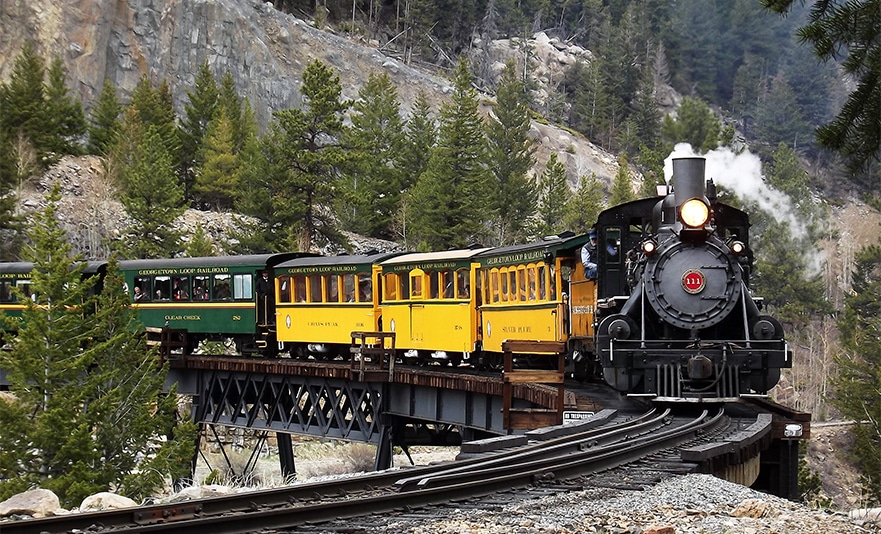
Before ski resorts, before national parks, before the interstate highway system, there was the Georgetown Loop Railroad — Colorado’s first major tourist attraction, drawing sightseers from across the nation since 1884. The engineering challenge was extraordinary: how to connect Georgetown and Silver Plume, lying just two miles apart but separated by more than 600 vertical feet, in the confines of a steep, narrow canyon? The solution was a corkscrew route nearly 4.5 miles long that looped back over itself, climbed grades of up to 4%, crossed four bridges over Clear Creek, and culminated in the crowning achievement: the Devil’s Gate High Bridge, a soaring 95-foot trestle that carried the train over the gorge in a feat of Victorian-era engineering that captured the imagination of the world.
At the height of its popularity, seven trains a day ran from Denver to the Georgetown Loop. Guidebooks, postcards, and pamphlets spread images of the steep canyon and mountain peaks to audiences across the country, making the Loop Colorado’s “must-see” destination. The arrival of the automobile eventually eroded ridership, and the original line was dismantled in 1939. But the Loop’s legend proved impossible to bury: in 1973, the Colorado Historical Society began the painstaking process of reconstruction, laying new track along the original grade with ties and rail donated by the Union Pacific Railroad. A new Devil’s Gate High Bridge was rebuilt to the original specifications, and the fully reconstructed line opened in 1984 to celebrate the 100th anniversary of its original completion.
Today, the Georgetown Loop Railroad remains one of the most memorable excursions in the Rocky Mountain West. A three-foot narrow-gauge steam locomotive hauls passengers through the Clear Creek canyon on a 4.5-mile round trip between Georgetown’s Devil’s Gate Station and Silver Plume, offering panoramic views of the surrounding peaks and ruins of old silver mines along the way. Riders can add an optional walking tour of the Lebanon Silver Mine, where guides lead visitors 500 feet into a tunnel bored in the 1870s, illuminating the harsh realities of 19th-century hard-rock mining. The Loop operates daily from May through Columbus Day and on weekends through December, with special themed excursions including haunted mine tours and Santa’s Lighted Forest Train rides during the holiday season.
A National Historic Landmark: Museums and Victorian Architecture
Strolling through Georgetown’s downtown is its own form of time travel. The Georgetown-Silver Plume National Historic Landmark District encompasses over 200 preserved Victorian-era structures, many of which can be visited on self-guided walking tours available from the Georgetown Gateway Visitor Center. The district is a rare, intact snapshot of a Colorado mining boomtown at the peak of its prosperity, with everything from grand private residences to civic buildings, churches, and commercial storefronts surviving largely as they were built in the 1860s through 1880s.
The Hotel de Paris Museum anchors the historic district at 409 6th Street and is consistently described as the most unique collection of early Colorado history in the state. Built in 1875 by eccentric French immigrant Louis Dupuy, the hotel served as a first-class French restaurant, luxurious inn, and showroom during the Gilded Age, attracting wealthy guests from across the country to its incongruously refined dining in the heart of the Rockies. The property is a site of the National Trust for Historic Preservation and contains remarkably well-preserved original furnishings, décor, and artifacts that evoke the period in vivid detail.
The Hamill House Museum at 305 Argentine Street offers a contrasting window into domestic Victorian life. Constructed between 1867 and 1879 for silver baron William A. Hamill, the Italianate home has been beautifully restored to its 19th-century appearance, complete with period furnishings, walnut woodwork, and an outhouse lined with zinc. Less well-known but equally fascinating is the Georgetown Energy Museum, housed in a fully functional hydroelectric power plant that has generated electricity continuously since 1900 — one of the oldest operating hydroelectric facilities in the United States. The Georgetown Firefighting Museum, located in the original 1880s firehouse on 507 5th Street, rounds out the town’s impressive roster of interpretive sites with an engrossing look at 19th-century fire protection.
Outdoor Adventures: Guanella Pass, Fourteeners, and Georgetown Lake
Georgetown punches far above its weight as a gateway to high-alpine adventure. The Guanella Pass Scenic and Historic Byway begins right at the southern edge of town and climbs through a stunning montane landscape of waterfalls, wildflower meadows, and dense evergreen forest to a summit of 11,660 feet. The paved road — open from Memorial Day weekend through mid-November — provides access to some of the most celebrated hiking in Colorado’s Front Range, including the approach to Mount Bierstadt, widely regarded as one of the easiest 14,000-foot peaks in the state to summit. The 14,060-foot mountain draws thousands of hikers each summer, and the well-maintained trail from the Guanella Pass trailhead offers a genuine high-alpine experience accessible to fit beginners. Square Top Mountain and the Abyss Lake Trail offer equally spectacular terrain for those seeking less-traveled routes.
Georgetown Lake, visible from I-70 as drivers enter town, is one of the closest spots to Denver for year-round fishing. The reservoir is stocked with rainbow trout and also holds wild brown trout, making it a productive destination for both spin and fly fishing. In winter, the lake is one of the metro area’s premier ice fishing spots, with ice thick enough to walk on most years. Clear Creek itself flows east from Georgetown through a canyon famous among Front Range anglers for its wild trout fishery. For mountain bikers and hikers, the Clear Creek Greenway Trail connects the Georgetown Loop’s Silver Plume Depot and Devil’s Gate Station, offering a scenic corridor through the canyon accessible to cyclists and pedestrians alike.
Winter brings its own draw to the Georgetown area. Loveland Ski Area lies just 12 miles west of town via I-70, making Georgetown a natural base camp — or a charming midway stop on the return from the mountains — for skiers and snowboarders. Loveland’s more than 1,800 acres of terrain and reputation for reliable snowpack draw dedicated Colorado skiers who prefer its no-frills character over the glitzier resorts further west on I-70. The ski area’s proximity to Georgetown, combined with the town’s affordable lodging options, makes the combination an appealing alternative to pricey resort stays.
Colorado’s Bighorn Sheep Capital
Few wildlife experiences in Colorado are as accessible — or as reliably spectacular — as watching bighorn sheep in Georgetown. The town sits within one of the largest bighorn sheep habitats in the state, and hundreds of these sure-footed animals navigate the rocky canyon walls and hillsides surrounding the valley. Year-round viewing stations at Georgetown Lake and the Georgetown Gateway Visitor Center provide reliable vantage points, and it is not unusual to spot bighorns from I-70 itself as drivers enter the canyon.
Each November, Georgetown celebrates its resident herd with the Bighorn Sheep Festival, a free community event held the second Saturday of the month in partnership with Colorado Parks and Wildlife. The festival features guided wildlife viewing hikes, educational presentations by wildlife biologists and conservation experts, live music, local food vendors, and a lively marketplace of crafts and artisan goods. The event draws visitors from across the Front Range and has become one of Clear Creek County’s signature annual gatherings — a fitting tribute to the animals that have become Georgetown’s unofficial mascots.
Dining, Breweries, and the Local Scene
Georgetown’s small size belies a surprisingly robust dining and drinking scene, concentrated along 6th Street and the surrounding blocks of the historic district. Coopers on the Creek is the town’s beloved anchor restaurant, decorated with mining-era photographs and serving a wide-ranging menu that spans from burgers and sandwiches to wild salmon and filet mignon — a reliable local favorite for decades. The Happy Cooker has long been a go-to for hearty breakfasts and lunches in a family-friendly setting. Georgetown Valley Candy Company draws visitors with its homemade chocolates, hand-crafted caramel corn, and ice cream, while Mountain Mamas’ Needful Things tempts passersby with freeze-dried candy and fresh baked goods.
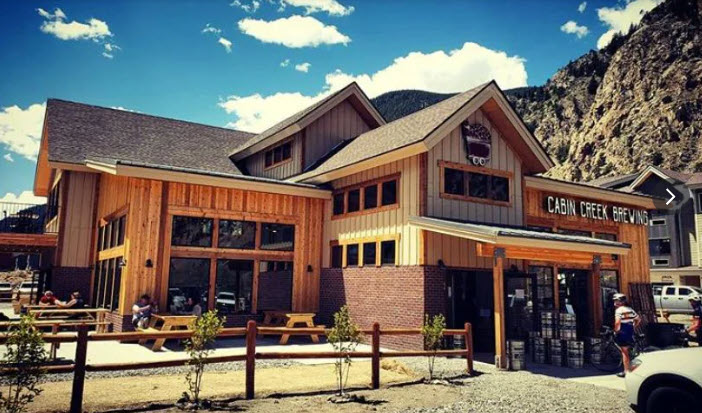
The craft brewing scene has taken hold in Georgetown as it has throughout Colorado. Guanella Pass Brewery and Cabin Creek Brewing Co. both offer rotating lineups of stouts, IPAs, wheat beers, and lagers alongside pub fare, and both have become community gathering spots that give the town a lively, unpretentious social energy. In February, Cabin Creek hosts its own Pond Hockey Tournament on Georgetown Lake — a three-on-three ice hockey competition that has grown into a beloved winter tradition, joining the Colorado Pond Hockey Tournament that draws teams from across the region for a multi-day event on the lake each winter.
The town’s annual event calendar has something for every season. The Fourth of July celebration features a classic small-town parade, barbecue, bandstand, and beer garden. The Georgetown Christmas Market each December transforms the Victorian streetscape into a magical holiday showcase, drawing visitors from Denver and beyond for handcrafted gifts, warm drinks, and the particular charm of a 19th-century mining town dressed for the holidays. Together, these events give Georgetown a community vitality that belies its modest population of just over 1,100 residents.
Alpine Climate and Best Times to Visit
At 8,530 feet, Georgetown enjoys a true Rocky Mountain alpine climate with cool, dry summers and snowy winters. Summer temperatures from June through August typically range from the mid-40s at night to the mid-70s during the day, with low humidity and the clear, brilliant sunshine characteristic of Colorado’s high elevations. Afternoon thunderstorms are common from July through early September, usually brief and dramatic. Fall from September through November is often considered the most magical season — temperatures drop into the 50s and 60s during the day, aspen groves turn brilliant gold, and the bighorn sheep are especially active on the surrounding hillsides.
Winter temperatures regularly dip below freezing, with the town receiving substantial snowfall that makes for a genuinely picturesque Victorian-era scene. Spring is the shoulder season, with unpredictable conditions — warm sunny days can alternate with late snowstorms well into April and even May. The Georgetown Loop Railroad operates from late spring through early winter, making late May through October the peak visitor season. For those coming specifically for the Christmas Market, holiday-season weekends in December are a wonderful time to visit despite the cold.
Planning Your Visit
Getting There: Georgetown sits directly on I-70 at Exit 228, approximately 45 miles (about one hour) west of downtown Denver. Denver International Airport is roughly 70 miles to the northeast. Eagle County Regional Airport (EGE) near Vail is approximately 65 miles west. There is no public transit directly to Georgetown from Denver, so a rental car or personal vehicle is recommended.
Getting Around: Georgetown’s historic downtown is compact and highly walkable. Most museums, shops, and restaurants are within easy walking distance of one another along 6th Street and the surrounding blocks. A car is helpful for reaching the Georgetown Loop Railroad’s Devil’s Gate Station (about a mile southwest of downtown), Georgetown Lake, and the Guanella Pass trailheads.
Best Time to Visit: Summer (June-September) for the Georgetown Loop Railroad, hiking, and warm weather. Fall (September-October) for spectacular aspen color and bighorn sheep viewing. December for the Georgetown Christmas Market. Winter for Loveland Ski Area access and Georgetown Lake ice fishing. The Loop Railroad and Guanella Pass are generally closed from mid-November through late May.
Lodging & Budget: Georgetown offers a range of accommodation options from historic bed-and-breakfasts — including the Rose Street Bed & Breakfast in an original 1800s home — to standard highway-adjacent hotels. Lodging is considerably more affordable than nearby Summit County ski towns, making Georgetown an excellent base for exploring the I-70 mountain corridor without paying resort prices. Book well in advance for Christmas Market weekends and summer holidays.
Whether you’re drawn by the steam locomotives and silver mines of the Georgetown Loop, the immaculately preserved streets of a Victorian-era boomtown, the trail to a 14,000-foot summit, or simply the chance to spot bighorn sheep from a roadside pullout, Georgetown delivers Colorado mountain character in its most authentic and accessible form. Its combination of genuine history, dramatic scenery, and small-town warmth — all within an hour of Denver — makes it one of the state’s most rewarding and underrated destinations.
Related Articles
Explore more Colorado adventures and expert guides:
- Idaho Springs, Colorado: Gateway to Clear Creek Canyon and the Mount Evans Wilderness
- Loveland Ski Area: Colorado’s Front Range Powder Paradise
- Silverton, Colorado: The Last of the Old West’s Silver Boom Towns
- Mount Bierstadt: A Beginner’s Guide to Summiting Your First Colorado Fourteener
- Guanella Pass Scenic Byway: One of Colorado’s Most Spectacular Drives