
Palisade, Colorado: The Peach Capital and Wine Country of the Western Slope
Right where DeBeque Canyon opens up on Colorado’s Western Slope, you’ll find Palisade. The Book Cliffs stand guard behind town—jagged walls of Mancos Shale—while the Colorado River snakes south, past orchards drooping with late-summer fruit. On paper, this place shouldn’t be a grower’s paradise. It’s all high desert, sagebrush, red sandstone—stuff that usually spells trouble for farming. But Palisade is different. The days run long and sunny, the nights cool off, and the growing season stretches out for a generous 182 days. Then there’s the real magic: every morning, a warm katabatic wind sweeps down DeBeque Canyon, just enough to keep spring frosts from killing the delicate blossoms. That’s how Palisade turned into the Rocky Mountains’ go-to spot for fruit and wine.
People rave about the peaches here. They’re big, impossibly sweet, so juicy you need a napkin—and Coloradans treat them almost like a religion. The local vineyards, too, keep stacking up national awards, and every fall, this town of just 2,500 fills up with visitors chasing the country’s best wine festival (at least, if you ask USA Today). In Palisade, farming isn’t some old story. It’s what keeps the town alive, and it’s at the heart of everything people love about this place.
Quick Facts
| County | Mesa County |
| Location | Western Slope of the Colorado Rockies; north bank of the Colorado River, 11 miles east of Grand Junction |
| Distance from Grand Junction | 11 miles east via US-6 or I-70 (15 minutes) |
| Distance from Denver | Approximately 245 miles west via I-70 (3 hours 45 minutes) |
| Elevation | 4,718 feet (1,438 m) — Colorado’s lowest-elevation wine and orchard region |
| Population | 2,565 (2020 census) |
| Incorporated | 1904 |
| Growing Season | 182 days — the longest of any agricultural region in Colorado |
| Nickname | “The Peach Capital of Colorado” |
| Notable Feature | Colorado’s premier wine country, with more than 25 wineries along the Palisade Fruit & Wine Byway; home of the Colorado Mountain Winefest, named Best Wine Festival in the nation by USA Today |
From Desert Sagebrush to Orchard Country: The History of Palisade
The land that would become Palisade was Ute territory for centuries — a desert river valley the tribe understood intimately, hunting its canyons and fishing its waters with a knowledge of the landscape’s rhythms and resources that no newcomer would quickly replicate. In 1881, following the forced removal of the Ute people from the Western Slope under the Brunot Agreement and subsequent federal pressure, the Grand Valley opened to Anglo-American homesteaders. What they found was not immediately encouraging: a wide, arid valley blanketed in sagebrush and bounded by the rust-and-gray Book Cliffs to the north, the land looking more like a setting for cattle grazing than a future agricultural paradise. The town took its name from those cliffs — their dramatic palisades of eroding Mancos Shale, carved by the Colorado River’s downcutting over millennia, visible from every corner of the valley floor.
The transformation of Palisade from desert to orchard began with irrigation and persistence, and both were provided in abundance by its earliest settlers. The first notable homesteader in the area was J.P. Harlow, who arrived in 1882 and immediately set about trying to grow peaches along Rapid Creek. His first crop died. Undeterred, Harlow experimented with soil amendment — burnt bones, leached ashes, and fish — and dug a small irrigation ditch to divert water from the creek to his trees. By 1885 his trees were surviving. By 1896 his orchard contained more than two thousand peach trees in what was likely the first successful large-scale peach crop in Colorado. He shared his techniques freely with neighboring farmers, and orchards began spreading through the valley. Harlow later served as Grand Junction’s first Justice of the Peace, his reputation as an agricultural pioneer secure.
The arrival of the Denver & Rio Grande and Colorado Midland Railroads in 1890 transformed Palisade’s agricultural ambitions from local enterprise into commercial industry. Refrigerated rail cars could now carry Palisade peaches to markets across the country before they spoiled, and the railroads’ promotional appetite for destination tourism helped spread the town’s name. By 1895, Peach Day — the forerunner of today’s Palisade Peach Festival — drew over 6,000 visitors, nearly tripling Grand Junction’s entire population at the time. The occasion featured parades, rodeos, and competitions, and the organizers sent boxes of peaches to newspapers across Colorado to generate press coverage. The strategy worked. Palisade peaches became a regional obsession and, within a generation, a statewide institution.
The early 20th century brought both expansion and setback. Coal mining had developed as a parallel economic engine beginning in 1884, when George Smith opened the Bookcliff Coal Mine west of Mount Garfield; eventually more than a dozen mines operated around Palisade, and coal production complemented the agricultural economy well into the mid-century. Prohibition, declared in 1920, devastated the wine industry almost overnight — vineyards that George Crawford had planted using European strains in the 1880s and that other settlers had expanded through the following decades were abandoned or converted to stonefruit, particularly peaches. The Great Depression further strained the town, and the federal government’s New Deal brought the Civilian Conservation Corps to Palisade, where CCC laborers shored up the Roller Dam and constructed the final sections of the Government Highline Canal — the 55-mile irrigation infrastructure that remains the agricultural lifeblood of the Grand Valley today. During World War II, the CCC camp was converted to hold German prisoners of war, who were employed as agricultural laborers in Palisade’s orchards.
The modern era of Palisade wine began in the 1970s, when a handful of farmers recognized that the same microclimate that produced exceptional peaches could support premium wine grapes. The Colorado wine industry was formally reborn in the valley over the following decades, and by the early 21st century Palisade had established itself as the center of Colorado’s only legitimate wine region, with more than 25 wineries operating along the Fruit & Wine Byway and annual production sufficient to supply tasting rooms, restaurants, and retail shops across the state. When the Public Service Company coal power plant at Cameo closed in 2010, ending the last chapter of Palisade’s industrial coal economy, the wine and orchard industries had long since filled the economic gap. Today, Palisade’s identity is defined entirely by what grows from its soil and the remarkable climate that makes it possible.
The Palisade Peach: Colorado’s Most Famous Agricultural Product
The Palisade peach is not merely a piece of fruit — it is a cultural institution, a seasonal event, and a point of pride so deeply embedded in Colorado identity that the first appearance of roadside fruit stands in late July is treated in the state with something approaching civic celebration. The peach’s remarkable flavor — consistently sweeter, juicier, and more aromatic than peaches from Georgia, California, or anywhere else in the country, according to the Coloradans who eat them — is the product of the same microclimate that makes Palisade’s agricultural success possible: hot days that drive sugar development in the fruit and cool nights that slow respiration, allowing those sugars to accumulate rather than burn off. Locals say you have to eat a Palisade peach over the sink.
The meteorological secret behind Palisade’s frost-resistance is the “million dollar wind,” as old-timers called it — a katabatic wind generated when warm air from higher elevations is compressed and accelerated through the narrow throat of DeBeque Canyon, pouring down into the Grand Valley at 5 to 10 miles per hour in the early morning hours when spring frosts threaten. This wind raises the temperature in the orchard belt just east of Mount Garfield by a few critical degrees, enough to save the delicate peach blossoms that would otherwise be killed by the late frosts that regularly destroy fruit crops elsewhere in Colorado. It is not a coincidence that virtually all of Mesa County’s 2,200 acres of peaches are concentrated in the area immediately downwind of DeBeque Canyon. The canyon is Palisade’s agricultural guardian.
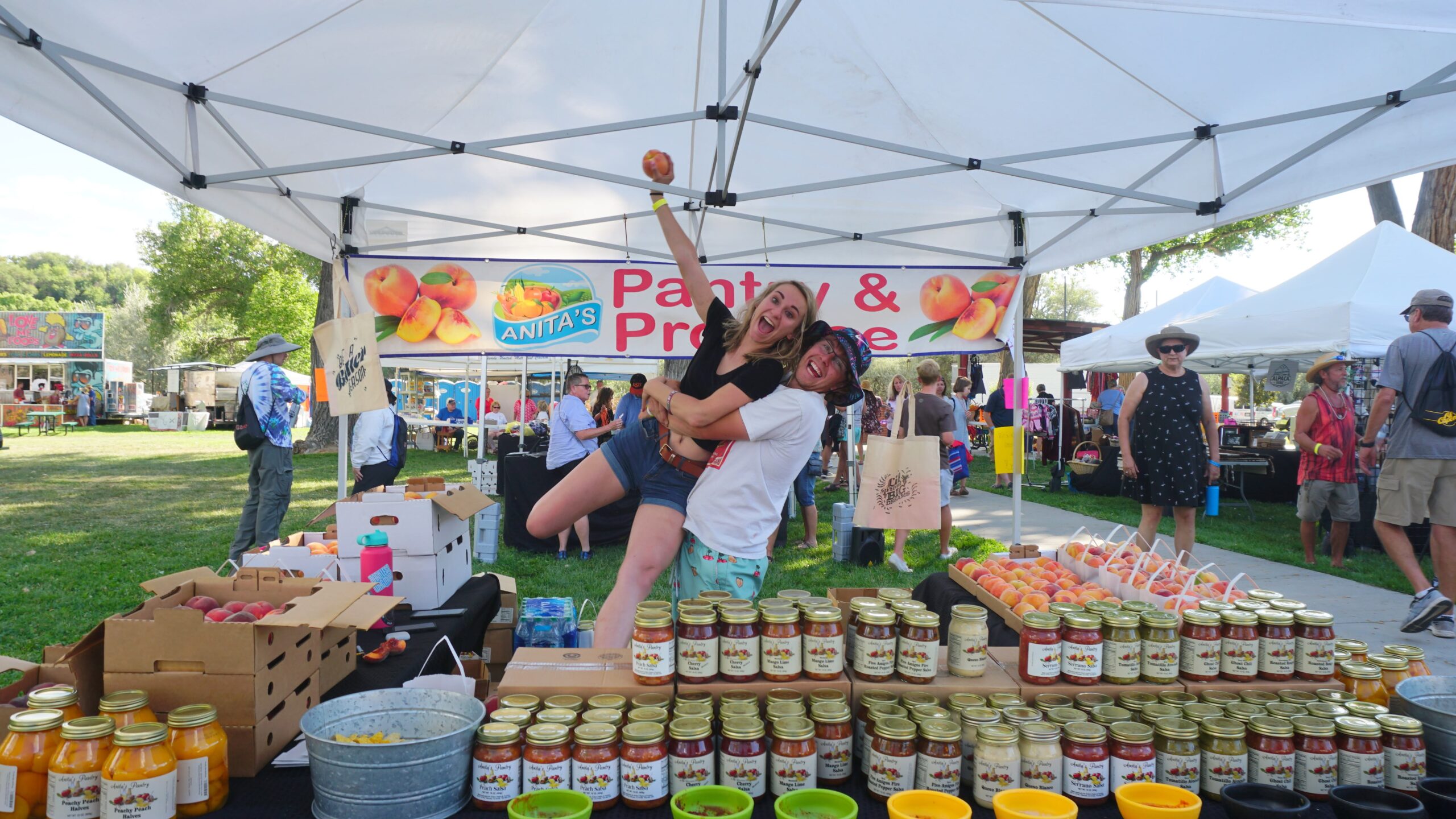
Peach season runs from late July through early September, with August as the peak, and during these weeks Palisade operates at a particular frequency of activity that the rest of the year does not quite replicate. Orchards open for u-pick operations and direct sales. Farm stands appear along every road into town, manned by farmers selling fruit by the basket, the flat, and the box. The Palisade Farmers Market, held Sundays from June through September in Riverbend Park, draws visitors and locals alike to browse produce, artisan goods, and live entertainment in the shade of the Book Cliffs. The annual Palisade Peach Festival in mid-August brings thousands of visitors to town for a full weekend of peach-themed food, cooking competitions, live music, and the particular joy of eating a perfectly ripe peach in the place where it was grown. Talbott Farms, a family-run operation for more than a century, is one of the largest growers in the valley and operates a farm store and cider house open year-round where visitors can sample peach cider, hard cider, and fresh produce.
Colorado Wine Country: The Palisade Fruit & Wine Byway
Colorado’s wine industry has its center of gravity in Palisade, and the Palisade Fruit & Wine Byway — a scenic route connecting more than 25 wineries, cideries, orchards, and farm stands across the agricultural lands east of Grand Junction — is the primary vehicle through which visitors experience it. The byway winds through the vineyard and orchard landscape between the Colorado River and the Book Cliffs, passing tasting rooms tucked into converted farm buildings, estate wineries with views across the vines to Mount Garfield, and roadside farm stands operated by families who have worked the same ground for three and four generations. The combination of high desert scenery, world-class agricultural product, and the unhurried pace of a small farming community gives the Palisade wine experience a character distinctly different from the commercial wine valleys of California.
The wineries of Palisade produce a range of varietals suited to the valley’s semi-arid, high-altitude microclimate. Merlot and Cabernet Franc thrive in the warm summers and well-drained soils. Chardonnay, Riesling, and Gewurztraminer benefit from the cool nights that preserve acidity and aromatic complexity. Many of the valley’s best-regarded producers practice estate winemaking, growing the grapes and producing the wine on the same property, and the resulting wines carry the specific character of Palisade’s terroir — a quality that has attracted increasingly serious critical attention from wine writers and competitions at the national level. Colterris, Carlson Vineyards, Maison la Belle Vie, and Two Rivers Winery are among the longtime producers, while newer operations have expanded the range of styles and price points available along the byway. Most tasting rooms are open daily and welcome walk-in visitors, making it easy to design a self-guided wine tour of any length.
Beyond the winery circuit, Palisade’s fermented beverage culture extends to brewing, distilling, and cidermaking. Palisade Brewing Company anchors the downtown drinking scene with a well-regarded lineup of craft beers and a taproom that serves as a community gathering place on summer evenings. Peach Street Distillers has earned national recognition for its fruit-forward spirits, most notably its whiskeys and vodkas and a peach brandy that has become a regional signature — a liquid distillation of the landscape in the most literal sense. Several cideries operating in and around Palisade leverage the valley’s apple and peach harvests to produce artisan hard ciders, completing a beverage ecosystem that gives Palisade more to drink than perhaps any other small town in Colorado.
The crown jewel of Palisade’s wine calendar is the Colorado Mountain Winefest, held annually in September at Riverbend Park along the Colorado River. Named the best wine festival in the nation by USA Today, the Winefest brings together dozens of Colorado wineries for a day of unlimited tastings, chef demonstrations, live music, grape stomping, ice carving, and educational seminars in a setting — open sky, river views, Book Cliffs as backdrop — that no winery district in the country can quite match. The festival has been running for more than three decades and is the primary fundraiser for the Colorado Association for Viticulture and Enology. The day before Winefest, the Tour de Vineyards cycling event sends riders along either a 23-mile Fruit & Wine Byway route or a challenging 58-mile course that climbs over Reeder Mesa, finishing with a celebratory brunch in downtown Palisade before attendees transition to the festival. Barrel Into Spring, held over two weekends in April and May, offers a more intimate early-season wine experience with barrel tastings and food pairings at participating wineries.
The Palisade Plunge and Outdoor Adventure
Palisade’s agricultural identity is so dominant that its credentials as an outdoor adventure destination sometimes receive less attention than they deserve — an oversight that mountain bikers in particular have begun correcting with enthusiasm. The Palisade Plunge, completed in 2020, is one of the most dramatic purpose-built mountain bike trails in the Rocky Mountain West: a 32-mile, point-to-point singletrack descent that drops 6,000 vertical feet from the plateau of Grand Mesa — at over 10,000 feet elevation, the world’s largest flat-topped mountain — all the way to the edge of downtown Palisade on the valley floor. The trail descends through a succession of ecological zones and terrain types, from the cool aspen forests and alpine meadows of the mesa through pinyon-juniper scrub to the open desert at the valley’s edge, with views expanding as the elevation drops until the entire Grand Valley spreads below in panoramic clarity. The Palisade Plunge is rated as a challenging advanced trail and is best experienced with a shuttle to the top and a celebratory finish at one of Palisade’s tasting rooms or breweries — an ending that few mountain bike trails in the country can offer.
The Palisade Rim Trail, a 13-mile out-and-back route that climbs from the valley floor to a ridgeline more than 1,000 feet above town, offers a more accessible adventure with exceptional rewards. Open to hikers, mountain bikers, and experienced equestrians, the trail traces the edge of the Book Cliffs above Palisade, providing sweeping aerial views of the vineyard and orchard landscape below, the Colorado River winding south, and Mount Garfield rising to the southeast. The exposure along the ridge demands caution near the edges but provides the kind of perspective on Palisade’s agricultural landscape that is impossible to appreciate from the valley floor — looking down on the patchwork of vineyards, orchards, and the town itself against the backdrop of the Grand Mesa is one of the most distinctive viewpoints in western Colorado.
The Little Book Cliffs Wild Horse Area, located northeast of Palisade and accessible by several trails from the valley, protects one of only three wild horse ranges actively managed on public land in Colorado and is home to a herd of wild horses that has roamed this section of the Book Cliffs for generations. Hiking or riding into the range offers the possibility of encountering the herd in genuine backcountry conditions — a wildlife experience available in very few places this accessible from a paved road. The Colorado River itself provides water recreation ranging from casual floating and paddleboarding in the gentle sections near Palisade to guided rafting trips through the canyon country east of town. Grand Mesa National Forest, rising immediately to the south and easily reached by scenic drive in approximately 45 minutes, offers more than 300 lakes, hundreds of miles of hiking and biking trails, and summer temperatures 20 to 30 degrees cooler than the valley floor.
Festivals, Events, and the Palisade Calendar
Palisade’s event calendar is as dense as its harvest season, and the two overlap deliberately — the town has built a festival culture that celebrates the agricultural and natural gifts of the Grand Valley with a regularity that gives visitors a strong reason to return in every season. The Palisade Bluegrass & Roots Festival in early June opens the summer season with three days of bluegrass and Americana concerts in Riverbend Park along the Colorado River, drawing nationally recognized artists alongside emerging local performers to a setting where the Book Cliffs provide a natural amphitheater backdrop. The Colorado Lavender Festival, also in June, centers on the valley’s lavender farms with cooking demonstrations, seminars, a lavender wreath-making class, and a celebration of the purple fields that have become an increasingly prominent feature of the Palisade agricultural landscape.
The Grand Valley Bank Brews & Shoes in May, which gathers more than 30 local craft ciders and beers from across the Grand Valley for an outdoor tasting event, reflects the depth of Palisade’s fermented beverage community beyond wine. The Palisade Peach Festival in mid-August marks the height of the harvest season and draws visitors from across Colorado to a full weekend of peach-inspired food, music, competitions, and the simple pleasure of eating fruit picked that morning. September brings the Tour de Vineyards cycling event and the Colorado Mountain Winefest in rapid succession, creating a wine country weekend that is among the most anticipated events on the Colorado autumn calendar. Christmas in the Country, held in December, offers horse-drawn carriage rides through Palisade’s decorated vineyards and orchards with stops for mulled wine and s’mores by the fire, closing the festival year with a particularly atmospheric celebration of the agricultural landscape in its winter rest.
Downtown Palisade: Farm Stands, Art, and Main Street
Downtown Palisade occupies a compact and walkable few blocks centered on Main Street and the surrounding streets, where the town’s historic commercial buildings — including the well-preserved Union Pacific Railroad Depot, a reminder of the rail connection that made commercial peach shipping possible in the 1890s — house a mix of tasting rooms, art galleries, farm stands, restaurants, and local shops that give the town a character both genuinely agricultural and quietly cosmopolitan. The Palisade Historical Society operates guided walking tours of the historic district along three routes, and self-guided brochure maps are available at the Chamber of Commerce for visitors who prefer their own pace.
Dining in Palisade is anchored by the agricultural abundance that defines the town, with restaurants and cafés making extensive use of locally grown fruit, wine, and produce in their menus throughout the season. Wine country dining is a particular strength — several wineries along the Fruit & Wine Byway offer food alongside their tastings, from charcuterie and small plates to full farm-to-table meals served in vineyard settings. Palisade Brewing Company provides the casual dining and craft beer anchor for the downtown, while the Sunday Farmers Market in Riverbend Park from June through September gathers the best of the valley’s producers — peaches, wine, lavender products, artisan foods, and handmade crafts — in a weekly community gathering that captures the essence of what makes Palisade worth lingering in.
Planning Your Visit
Getting There: Palisade sits 11 miles east of Grand Junction along US-6 or I-70, accessible via Exit 42 from I-70. From Denver, take I-70 West approximately 245 miles through Vail Pass, Glenwood Canyon, and DeBeque Canyon — a spectacular drive of roughly 3 hours 45 minutes. Grand Junction Regional Airport (GJT), served by several major carriers, is 15 minutes west of Palisade and is the most convenient air gateway to the Grand Valley. Palisade is also served by Amtrak’s California Zephyr, which stops at the Grand Junction station.
Getting Around: Palisade’s downtown is fully walkable, and the Fruit & Wine Byway is most enjoyably navigated by bicycle — several shops in town and Grand Junction rent bikes for the day, and the flat to gently rolling orchard roads are well-suited to cycling of all fitness levels. For the Palisade Plunge, shuttle services operate from downtown Palisade to the Grand Mesa trailhead. Guided wine tours by horse-drawn carriage, limousine, and bicycle are available through local operators for visitors who prefer not to navigate independently.
Best Time to Visit: Late July through September is peak season — peach harvest is underway from late July, the Bluegrass Festival and Lavender Festival bring June alive, August peaks with the Peach Festival, and September’s Tour de Vineyards and Colorado Mountain Winefest cap the harvest season with Palisade at its most festive. Spring (April through May) is beautiful for the orchard blossoms and offers the Barrel Into Spring wine events with smaller crowds. Winter is quiet but not without appeal: the vineyards are stark and scenic, Christmas in the Country offers carriage rides and firelit tastings, and the lack of summer crowds makes for unhurried exploration of the tasting rooms that remain open year-round.
Lodging: Palisade offers a concentrated selection of wine country-style accommodations, including several bed-and-breakfasts and inns set among the vineyards and orchards along the Fruit & Wine Byway. Grand Junction, 15 minutes west, offers the full range of hotel options for visitors who prefer a larger city base and day trips into wine country. Camping is available in Grand Mesa National Forest above the valley, providing a dramatically different experience — cool alpine temperatures and mountain scenery — in easy proximity to the valley’s warmth and produce.
Whether you arrive in August with a cooler and a mission to bring home the season’s best peaches, in September for the choreography of the wine harvest and the convivial chaos of Winefest weekend, or in the quiet of an October afternoon to ride the Palisade Rim with the vineyards turning gold below, Palisade delivers an experience of Colorado that has nothing to do with ski resorts or mountain summits and everything to do with the patient, sensory richness of a landscape that has been carefully cultivated for more than a century. It is one of the most distinctive small towns in the American West, and one of the sweetest in every sense of the word.
Related Articles
Explore more Colorado adventures and expert guides:
- Colorado Wine Country: A Complete Guide to the Palisade Fruit & Wine Byway
- The Palisade Plunge: Riding Colorado’s Most Epic Mountain Bike Descent
- Grand Mesa National Forest: The World’s Largest Flat-Topped Mountain
- Grand Junction, Colorado: Gateway to the Colorado National Monument and Wine Country
- Palisade Peach Festival: Planning Your Late-Summer Visit to Colorado’s Orchard Country