
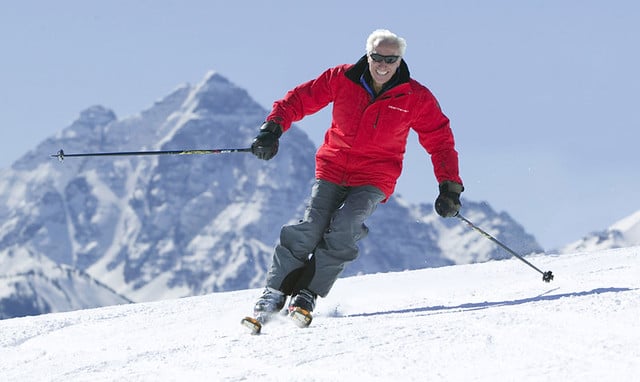
Klaus Obermeyer made his first pair of skis at the age of three, out of chestnut slats pried off an orange crate, with his house shoes nailed to the top. He was still skiing Aspen Mountain at 102. In between he built the American ski clothing industry more or less from scratch, out of an attic, using his mother’s bedding.
He turned 106 in December 2025, and he is still the reason a lot of people can stand being outside in a Colorado winter.
If you have ever worn a down jacket, put on sunscreen at 11,000 feet, pulled a turtleneck over your head, or watched your ski stop itself after a yard sale instead of rocketing down the hill at somebody’s kneecaps, you have used something Klaus Obermeyer either invented or made practical. Most Coloradans have never heard his name. Here is the story.
From an Orange Crate in Bavaria
Klaus Obermeyer was born on December 2, 1919, in Oberstaufen, a village in the Bavarian Alps where skiing was not a sport so much as how you got to the next village between November and April.
He grew up on a remote farm, which is where the resourcefulness comes from. The orange-crate skis at age three were not a charming anecdote at the time, they were the only way a farm kid was getting skis. At four his mother managed to get him real ones from the father of Stein Eriksen, the Norwegian who would go on to win Olympic gold. Obermeyer has called them “an absolute luxury,” and given what he was replacing, that tracks.
He came to the United States in 1947, after the war, with very little. What he had was an Austrian friend named Friedl Pfeifer, who had just started the ski school at a half-abandoned Colorado silver town called Aspen and needed instructors who could actually ski.
The Comforter That Became an Industry
Obermeyer’s mother sent him off to America with a goose-down comforter. It is the single most consequential piece of bedding in the history of American outerwear.
Teaching on Aspen Mountain, he noticed his students were quitting early, not because they were bad at skiing but because they were freezing. Ski clothing in 1947 was wool, and wool at 11,000 feet in February is a losing proposition. So he cut up the comforter and sewed it into a parka.
It worked. It also leaked feathers across the mountain, which is why early Aspen locals reportedly could track him by the trail. The first one he sold went to Gary Cooper, who was skiing Aspen at the time, which tells you something about what Aspen already was in 1947.
Sport Obermeyer was founded that same year, run out of the attic of his house, while he kept teaching. He spent twelve years as a ski instructor on Aspen Mountain before the company could support him on its own.
What Klaus Obermeyer Actually Invented
This is the part that gets underplayed. Obermeyer was not a clothing designer who got lucky. He was a serial product inventor working on a specific problem: skiing was miserable, and miserable is bad for business.
The innovations credited to him include:
- The quilted down ski parka (1947), stitched from his own down comforter.
- The first mirrored ski sunglasses, using vaporized metal on the lens, developed in the early 1960s as the Rallye model.
- The first nylon windshirt, the ancestor of every shell layer sold today.
- The first high-altitude suntan lotion, developed with Friedl Pfeifer. At Aspen’s elevation, with snow reflecting UV back up at you, skiers were getting badly burned in conditions where sunscreen was not something anyone thought about. Obermeyer and Pfeifer produced the first lotion formulated for that problem. Every tube of alpine sunscreen sold today traces back to it.
- The two-layer ski boot, the first with a warm inner liner inside a rigid outer shell. This is now simply how ski boots are built.
- The first turtlenecks with elasticized collars, which the company still calls “turtles.”
- The dual-pane goggle lens, which is why your goggles do not fog.
- The two-pronged ski brake, the small spring-loaded arms on your binding that flip down and stop a released ski. Before this, skis were tethered to your leg with a leash, and a released ski would whip around and hit you. The two-prong brake is still the standard mechanism on essentially every alpine binding made.
That last one is worth sitting with. A ski brake is a ten-cent piece of bent metal that has prevented an incalculable number of injuries, and most skiers have never once thought about where it came from.
Why He Stayed in Colorado
Obermeyer could have built this anywhere. He stayed in Aspen, and his reason was meteorological.
“The air is very dry and makes us wonderful powder snow,” is how he has put it. Colorado’s continental snowpack, dry and light because the storms have already wrung themselves out crossing the Great Basin, is the thing that made Aspen worth the trouble in 1947 and still is.
He arrived when Aspen was a played-out mining town with a few hundred residents rattling around Victorian buildings left over from the silver boom. Our look at Colorado’s mining history covers what the town had been. Pfeifer, who had served in the 10th Mountain Division training at Camp Hale up the valley, saw what the terrain could become. The 10th Mountain veterans seeded ski areas across the West after the war, and the 10th Mountain Division huts still thread the backcountry between Aspen, Vail and Leadville.
Obermeyer was one of the people who turned a mining ghost town into a ski town, and then made the ski town wearable.
The Longevity Question
People ask him about this constantly, and he gives the same unglamorous answer.
“One should do at least one hour each day of physical exercise, all your life.”
He swam half a mile a day into his hundreds. He has practiced aikido for decades. He played tennis, ran, and skied until 102. He plays music. He yodels, which he will do on request and which is somehow not a bit.
On retirement he is blunt: “To me, retiring means to give up.” He was still serving as CEO of his company at 98.
He stopped skiing at 102, which he does not describe as quitting. He says he still skis every night in his dreams.
Where to See the Legacy
Aspen is the obvious pilgrimage. The town where Obermeyer taught for twelve years is now one of the most recognizable ski destinations on earth, and its four mountains still run the terrain he learned on. See our guide to skiing Aspen, and if you want the full Aspen experience, The Little Nell sits at the base of Ajax.
Up and down the Roaring Fork Valley, the towns that support Aspen are worth as much of your time as Aspen itself. Snowmass has the biggest vertical of the four mountains. Basalt and Carbondale are where the valley feels like a real place. Glenwood Springs anchors the bottom of the valley with the hot springs that were drawing people here before anyone strapped on a ski.
Sport Obermeyer is still headquartered in Aspen, which makes it one of the longest-running Colorado-made brands in the state, and a fair answer to the question of what Colorado is known for.
Honors
- U.S. National Ski and Snowboard Hall of Fame, inducted 1997
- Colorado Business Hall of Fame, inducted 2015
The Part Worth Remembering
There is a version of this story that is just about products. Parka, sunscreen, goggle, brake. That version misses it.
What Obermeyer actually did was notice that people were cold, sunburned, fogged in and getting hit by their own equipment, and that all of those problems were solvable. He solved them one at a time, over seventy-five years, out of an attic in a town of a few hundred people. The industry that grew around Colorado skiing, the one that now moves billions of dollars a year through towns from Aspen to Steamboat, is built on the fact that somebody made it bearable to stand outside.
If you are planning a Colorado ski trip, our guides to when Colorado ski resorts open and the best ski areas for beginners will get you started. Wear a down jacket. Put on sunscreen. Thank Klaus.Suggested tags