
Glenwood Springs, Colorado: The World’s Largest Hot Springs Pool, a Canyon That Took 12 Years to Cross, and Doc Holliday’s Last Stop
There are prettier mountain towns in Colorado and there are cheaper ones. There is no other town where you can soak in a block-long pool of 104-degree mineral water in the morning, ride a roller coaster on top of a mountain in the afternoon, and eat dinner in a building where Doc Holliday drank himself toward the end. Glenwood Springs has been selling the same thing for 140 years, which is hot water coming out of the ground at a rate most towns would consider showing off, and it has quietly built a very good town around it.
It sits at 5,761 feet where the Roaring Fork River meets the Colorado, low enough that flatlanders sleep fine and the shoulder seasons stay usable. About 10,000 people live here. The town is the seat of Garfield County, 150 miles west of Denver on I-70, and it functions as the working-class counterweight to Aspen 40 miles up the valley: the place where the people who make Aspen run actually live, and where a family can afford a weekend.
It is also a town that has been tested. A wildfire in 2020 burned 32,631 acres of the canyon on its doorstep. The debris flows that followed in 2021 caused what the state calls the most destructive infrastructure damage in the history of the I-70 mountain corridor. Glenwood Springs came back. Hanging Lake is open again. The bike path runs end to end. This is a good year to visit.

| Quick Facts | |
|---|---|
| Elevation | 5,761 feet |
| Population | 9,963 (2020 census) |
| County | Garfield County (county seat) |
| Founded | 1885, originally called Defiance |
| From Denver | 150 miles west on I-70 (~3 hours) |
| From Aspen | 42 miles up the Roaring Fork Valley |
| Rivers | The Colorado and the Roaring Fork meet in town |
| Known for | Hot springs, Glenwood Canyon, Hanging Lake, Doc Holliday’s grave |
From Defiance to Glenwood Springs
The Ute people were here first, and they knew exactly what they had. They called the big spring Yampah, meaning “big medicine,” and treated the water as sacred and medicinal long before anyone thought to charge admission for it.
The settlement that became Glenwood Springs was founded in the 1880s as a rough camp called Defiance, which tells you what kind of place it was. Sarah Cooper, wife of founder Isaac Cooper, campaigned to rename it after her hometown of Glenwood, Iowa, and won. The town incorporated on September 4, 1885.
Silver money built what came next. Walter Devereux, a mining engineer who made his fortune in Aspen, looked at the hot spring and saw a European-style spa resort. He built the bathhouse, then in 1893 he built the Hotel Colorado, modeled on an Italian villa, at a scale that made no sense for a town of a few thousand people. It made sense as a destination, and it worked. Presidents came. Theodore Roosevelt first visited in 1901 as Vice President, came back repeatedly, and ran the country from the hotel for three weeks during a 1905 bear hunt. Taft followed in 1909. During World War II the building served as a U.S. Naval Convalescent Hospital, treating more than 6,500 patients between 1943 and 1946.
The other famous name got here first and stayed permanently. Doc Holliday arrived in May 1887, tubercular and 36 years old, hoping the vapor caves and mineral water would do what nothing else had. They did not. He died on November 8, 1887, at the Hotel Glenwood.
The Hot Springs
This is the reason the town exists, and there are three genuinely different experiences. Do not treat them as interchangeable.
Glenwood Hot Springs Resort
The big one, and the one people picture. The Grand Pool is billed as the world’s largest hot springs pool, a block-long expanse of mineral water that has been the center of the town since the 1880s. Alongside it sits a smaller and considerably hotter therapy pool, plus the Sopris Splash Zone for kids. The water carries 15 minerals and comes out of the Yampah spring at volume.
It is open 9 a.m. to 9 p.m. year round. Day passes run roughly $38 to $60 for adults and $27 to $38 for children depending on season, so check current rates before you budget. Guests at the on-site Glenwood Hot Springs Lodge get pool access included with the room, which changes the math considerably if you are staying two nights.
Winter is the best time. Steam coming off a pool that size at 20 degrees, with snow on the canyon walls above you, is the single most Colorado thing in this town.
Iron Mountain Hot Springs
The quieter, more deliberate option, at 281 Centennial Street on the bank of the Colorado River. Where Glenwood Hot Springs is one enormous pool, Iron Mountain is a collection of more than 30 smaller soaking pools running from about 89 to 108 degrees, each a different temperature, terraced down toward the river. You work your way through them.
The recently opened Sauna Summit expansion added five saunas and three plunge pools, built around contrast bathing traditions borrowed from Turkey, Finland, Korea, Russia and Poland, plus dedicated magnesium and potassium mineral pools. Cold plunges run 45 to 55 degrees. Open 9 a.m. to 10 p.m. daily.
If Glenwood Hot Springs is a public pool, Iron Mountain is a spa. Pick accordingly.
Yampah Spa and Vapor Caves
The strangest and oldest of the three, at 709 E 6th Street, in continuous operation since 1893. These are three underground rock chambers with geothermal mineral water flowing beneath the floor at 125 degrees, filling the caves with natural mineral steam. The chambers themselves sit around 110 to 113 degrees. It is a steam bath, not a soak, and the Ute people used it long before the building existed.
Yampah bills itself as the only known natural vapor caves in North America. Sessions of 10 to 12 minutes with cool-down breaks are the recommendation, and you will want them. A full spa operates upstairs with massage, facials and private mineral baths.
Important change: reservations are now required for the vapor caves and all services. The old walk-in model is gone. Call ahead.
If you are working through the state’s geothermal water, our guides to hot springs near Denver, soaking in Ouray and Pagosa Springs cover the rest of the circuit.
Glenwood Canyon
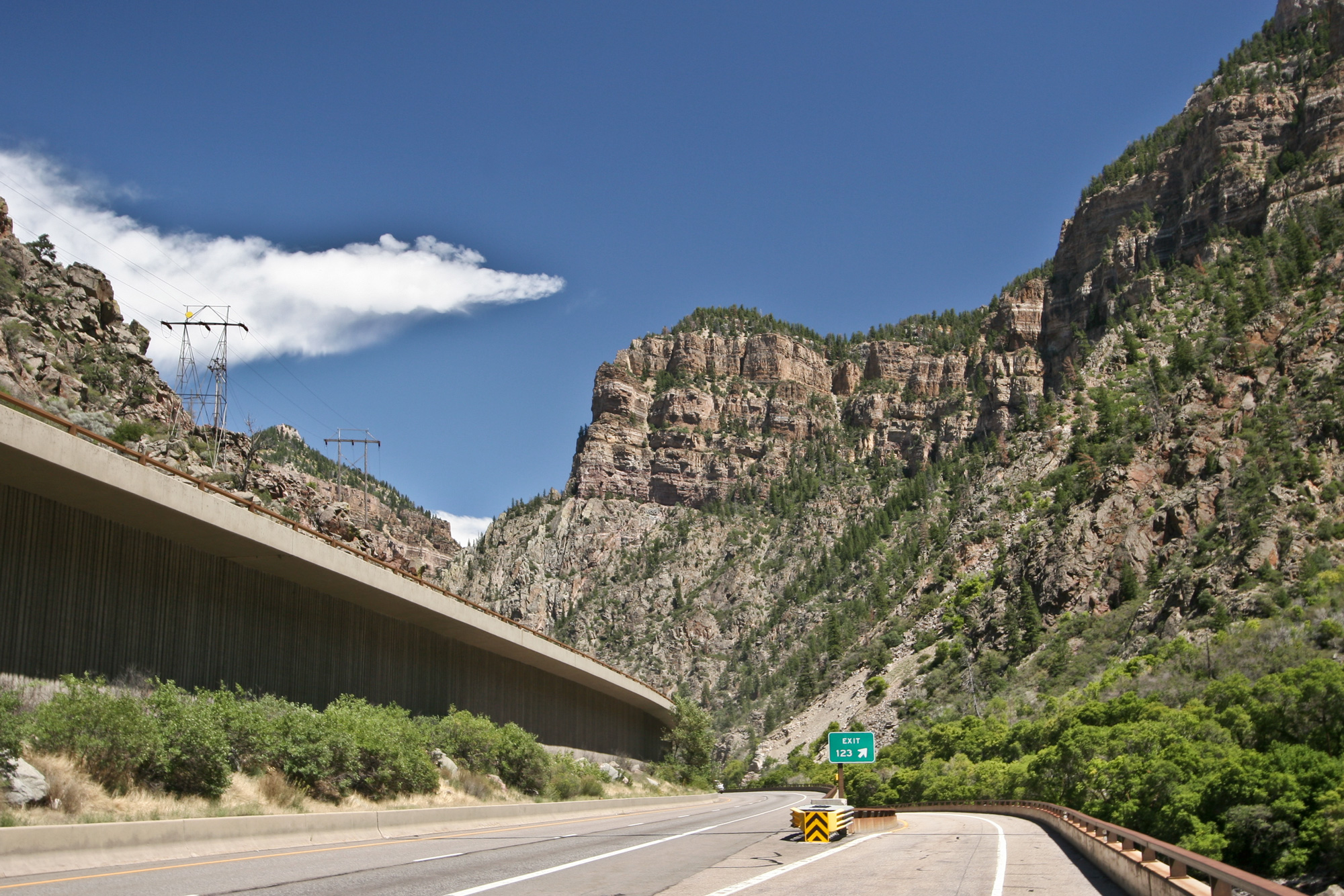
Twelve and a half miles of limestone gorge east of town with walls up to 1,300 feet, the Colorado River at the bottom, and one of the great feats of American civil engineering threaded through it.
The highway itself
The I-70 segment through Glenwood Canyon was the last piece of the Interstate Highway System ever built, opening to traffic on October 14, 1992 after twelve years of construction and $490 million. The engineering problem was that a normal highway would have destroyed the canyon. The solution was to put most of the road in the air: 40 bridges and viaducts, three tunnels, and 15 miles of retaining walls, with the two directions running at different elevations and the concrete piers rusticated and tinted to match the rock. It won more than 30 awards, including the American Society of Civil Engineers’ top honor in 1993.
Drive it slowly. There are four rest areas, and pulling into any of them is more rewarding than most scenic overlooks you will pay to see.
Hanging Lake
The most photographed hike in western Colorado, and it is open.
The trail climbs 1,200 feet in about 1.2 miles, crossing seven bridges on relentless switchbacks, to a turquoise lake perched on a shelf with a waterfall pouring into it. Round trip takes about three hours for most people. It is steep, rocky and genuinely strenuous, and it is not a good choice for small children.
You need a timed reservation, year round. Permits run about $12 per person in the warm season and $10 in winter, include trailhead parking, and are booked hourly through visitglenwood.com. Each permit gives a three-hour window and you should arrive within 30 minutes of your time. There is no shuttle, and Uber, taxis and rideshares are prohibited for drop-off and pickup. If someone is dropping you, their vehicle must be out of the lot by 4 p.m. You can also ride in on the canyon bike path with a standard permit.
No dogs, no swimming, no drones, and stay on the trail. The lake is fragile and the rules exist because it nearly got loved to death.
The Glenwood Canyon Recreation Trail
About 16 miles of paved path from Glenwood Springs east to Dotsero, following the river through the canyon on a gentle grade that almost anyone can ride. As of this month it is open along all six segments. Access points at the No Name, Grizzly Creek, Hanging Lake and Bair Ranch rest areas let you ride one direction and shuttle back.
It closes seasonally in late fall and can close for high water. Rentals are easy to find downtown.
What happened here, and the honest risk today
The Grizzly Creek Fire started August 10, 2020, caused by chains dragging from a truck. It burned 32,631 acres, the largest fire in White River National Forest history, and closed I-70 for roughly two weeks.
The following summer the burn scar did what burn scars do. On July 31, 2021, debris flows tore through the canyon and caused what CDOT calls the most destructive infrastructure damage in the history of the I-70 mountain corridor. Crews hauled out hundreds of truckloads of rock and mud. Restoration took two years.
Five years on, researchers report the burn scar is recovering well, and CDOT relaxed its canyon closure protocols in 2025 specifically because debris-flow potential has dropped. A flash flood warning no longer automatically closes the highway.
The practical takeaway: the risk is materially lower than it was, but weather closures still happen and there is no good detour. Check COtrip.org before you drive the canyon, and carry water, food and any medication you need in the car rather than in the trunk.
Outdoor Recreation in Glenwood Springs
Rafting the Colorado
Two rivers meet in town, which gives outfitters an unusual range. The marquee run is Shoshone, on the Colorado inside Glenwood Canyon, minutes from downtown: a compact stretch of Class III water with named rapids including Entrance Exam, Tombstone and The Wall, usually about two and a half hours on the river. Above 6,000 cfs it becomes Class IV and commercial trips stop running it, which mostly matters in June.
For something gentler, the Grizzly Creek to Two Rivers Park float is Class II to III and ends in town, and the Roaring Fork runs Class I to III. Season runs roughly April through October, with high cold water in May and June, warm medium flows and crowds in July and August, and quiet low water in September.
Established outfitters include Blue Sky Adventures, family-owned and running trips here since 1975, Defiance Rafting and Whitewater Rafting LLC.
Hiking beyond Hanging Lake
Doc Holliday Trail is the short one everyone should do: 0.7 miles round trip from 12th Street and Bennett Avenue, uphill and steep near the top, to Linwood Cemetery. More on what you find there below.
Red Mountain / Jeanne Golay Trail runs 2 to 7 miles depending on your turnaround, moderate to difficult, with the best overhead view of town. It is named for a local cyclist who won three national road racing championships in the 1990s.
No Name Trail, also called Jess Weaver Trail, leaves from I-70 Exit 119 and follows a creek with waterfall views. Two warnings: parking fits only about six vehicles and fills on summer weekends, and the upper section between mileposts 2.8 and 3.5 is currently closed.
Grizzly Creek Trail is closed. A Forest Service order closes everything past milepost 0.3 through December 31, 2026 for fire-damage restoration and bridge replacement. Do not plan around it.
Sunlight Mountain Resort
Ten to twelve miles south of downtown, about 15 minutes, and one of the genuinely good arguments for Glenwood Springs as a ski base. Sunlight opened in 1966 and has a 2,010-foot vertical drop, around 740 acres, and roughly 77 trails, including The Heathen at 52 degrees, among the steepest inbounds runs in the state. It averages about 250 inches of snow.
The pitch is affordability and it is not marketing spin. Lift tickets start around $74, kids 12 and under ski free, parking is free, and a $5 shuttle runs from town. The resort replaced two lifts before the 2025-26 season, retiring a chair that had been running since 1954 and was the oldest operational lift in Colorado.
The classic Glenwood day is ski Sunlight, then soak. Our roundup of the best ski areas for beginners puts it in context, and we track when Colorado ski resorts open each fall.
Glenwood Caverns Adventure Park
America’s only mountaintop theme park, at 7,160 feet on Iron Mountain, reached by the orange Glenwood Gondola from a base station in town.
Two National Natural Landmark cave tours run through genuine limestone caverns, which is what the mountain was known for long before the rides arrived. Then there are the rides, and they are not gentle. Defiance is the highest looping roller coaster in the United States. The Giant Canyon Swing launches you out over Glenwood Canyon with 1,300 feet of air beneath your boots. The Alpine Coaster runs down the mountain on rails you control.
Open year round across all four seasons. Buy tickets ahead, which is cheaper than at the gate. Seniors 65 and up and military get discounts in person.
Even if thrill rides are not your thing, the gondola and the caves are worth the trip, and the view down the valley is the best paid view in town.
Downtown, Food and Drink
Downtown Glenwood Springs is compact, walkable and genuinely lived in, centered on Grand Avenue and Seventh Street. Seventh is the restaurant row.
Where to eat. Juicy Lucy’s Steakhouse at 308 7th Street works out of a late-1800s building and cuts its own Colorado beef, with elk and lamb on the menu and a wine list that has won awards. The Pullman at 330 7th does upscale-casual New American in a small room. Riviera Supper Club & Scratch Kitchen at 702 Grand is the downtown landmark, open Wednesday through Sunday evenings, with more than 20 Locals’ Choice awards on the wall. Slope & Hatch at 208 7th is the cheap, creative, excellent option: tacos and hot dogs with real ambition. Smoke Modern Barbeque at 713 Grand is closed Mondays and worth planning around.
Two only-here places. Vicco’s Charcoalburger Drive-In has been grilling burgers over charcoal on Highway 6 since 1953. Sweet Coloradough makes honey-sweetened doughnuts in more than a hundred daily varieties and has been voted the best in the state.
Where to drink. Casey Brewing & Blending is the serious one, and beer people plan trips around it: Belgian-style oak-aged sour and wild ales made with almost entirely Colorado ingredients. The taproom is at 711 Grand Avenue and the Barrel Cellar is at 3421 Grand, and tours run only at the cellar. Glenwood Canyon Brewpub at 402 7th Street calls itself the most awarded brewery on the Western Slope and pours Hanging Lake Ale and Vapor Cave IPA, which tells you where you are. Doc Holliday’s Saloon at 724 Grand leans all the way into the theme with a twenty-foot neon pistol sign and a restored walnut back-bar. For the wider picture, see our Colorado brewery directory.
Doc Holliday’s Grave
Walk up the Doc Holliday Trail to Linwood Cemetery and you will find a monument to the most famous man buried in Glenwood Springs. What you will not find is Doc Holliday.
He got a pauper’s funeral in an unmarked, shallow grave in November 1887. The cemetery’s records were lost or destroyed after the city bought the property in 1939. The Chamber of Commerce erected a memorial in the 1950s, replaced in 2004 to fix errors, and its inscription is admirably honest about the situation. It reads, in part, that this memorial is dedicated to Doc Holliday “who is buried someplace in this cemetery.”
History Colorado and the town’s own tourism office both say plainly that nobody knows the exact spot. That is a better story than a tidy grave, and the walk up is short.
While we are correcting the record: Doc Holliday never stayed at the Hotel Colorado. He died six years before it opened. The hotel labels the claim fiction on its own website.
Where to Stay
Hotel Colorado, 526 Pine Street, is the historic choice and the one with the stories. Built in 1893, Roosevelt’s temporary White House, a naval hospital during the war, and directly across from the hot springs pool.
A note on the famous legend: the hotel is often credited with the invention of the teddy bear during Roosevelt’s 1905 bear hunt, when staff supposedly sewed him a stuffed bear from scraps. The documented origin is a 1902 hunt in Mississippi and a Washington Post cartoon that followed. To its credit, the Hotel Colorado says exactly that on its own site and calls the truth fuzzy. Enjoy the story, just do not repeat it as fact.
Glenwood Hot Springs Lodge, 415 E 6th Street, has 107 renovated rooms and includes hot springs pool access with every stay, which is the practical winner for a soaking weekend. The same resort recently opened Hotel 1888, a 16-room boutique property in the historic Stone Bath House with unlimited pool access.
Hotel Maxwell Anderson at 402 7th Street is the downtown boutique option. Note the name: it was The Hotel Denver until it was rebranded in 2024, so older guides and your GPS may still call it that. Glenwood Canyon Brewpub is in the same building.
Beyond town, our guides to Colorado RV parks and glamping in Colorado cover the I-70 corridor options.
Annual Events
- Strawberry Days, the third full weekend in June at Two Rivers Park. Free admission. The 2026 festival was the 129th annual, which makes it the oldest continuously held civic celebration west of the Mississippi and puts its founding around 1897. Free strawberries and ice cream after Saturday’s parade, an artisan fair, a beer garden, the Strawberry Shortcut races on Sunday morning, and a drone show.
- Oktoberfest at the Hotel Colorado in September, and a separate Octoberfest at Glenwood Caverns in October. Two events, two spellings, both real.
- Ghost Walk at Linwood Cemetery, typically the last two or three weekends of October, run by the Glenwood Springs Historical Society with costumed performers portraying real people buried there.
- Hotel Colorado Lighting Ceremony, the Friday after Thanksgiving, which opens Winter Wonderland: a townwide holiday run from the day after Thanksgiving through New Year’s Day with light displays, markets, ice skating and a gingerbread competition. It fits neatly into a broader Christmas in Colorado trip.
- Ski Spree and the Snowshoe Shuffle at Sunlight in February, and the Defiance Challenge endurance race in spring.
Specific dates move, so confirm with the chamber before booking around any of them.
Day Trips from Glenwood Springs
Aspen and the Roaring Fork Valley (42 miles)
Forty minutes up Highway 82 through Carbondale and Basalt, both of which are worth a stop in their own right and both considerably easier on the wallet than the town at the end of the road. Snowmass sits just short of Aspen.
Palisade and wine country (85 miles)
Ninety minutes west on I-70 puts you in Colorado’s fruit belt. Peaches from mid-July into September, tasting rooms year round. See our guide to the Palisade Fruit & Wine Byway and the Palisade town page.
Grand Mesa (about 60 miles)
The largest flat-topped mountain in the world, with more than 300 lakes on top and a scenic byway across it. A completely different landscape from the canyon, and usually empty. Grand Junction makes a natural pairing.
Marble and the Crystal Mill (about 50 miles)
South past Carbondale, a rough road leads to the most photographed mill in Colorado and the quarry that supplied the marble for the Lincoln Memorial. High-clearance vehicle recommended for the final stretch.
Planning Your Visit to Glenwood Springs
Getting there. Straight down I-70 at exit 116, about three hours from Denver in good conditions. The canyon east of town can close for weather, so build slack into a winter drive and check COtrip.org.
By train, which is the better way. Glenwood Springs is a stop on Amtrak’s California Zephyr, and the run from Denver through the Moffat Tunnel and down Glenwood Canyon is one of the most scenic rail journeys in North America. The depot is downtown, walking distance from the hot springs. Our guide to scenic Amtrak routes covers the route, and the complete guide to Colorado train rides covers the rest.
Getting around. Downtown, the hot springs, the gondola base and the Amtrak station are all walkable from each other, which makes this one of the few Colorado mountain towns where you can genuinely skip the car for a weekend. Sunlight, Hanging Lake and the canyon trailheads need wheels or a shuttle.
Best time to come. September and October are the sweet spot: warm days, cool nights, low river, thin crowds and gold on the canyon walls. Winter is the case for the hot springs, with steam and snow and cheap lift tickets fifteen minutes away. June brings Strawberry Days and the biggest water of the year. July and August are hot and busy. For the wider view, see our guide to the best time to visit Colorado.
Book Hanging Lake first. If it is on your list, reserve the permit before you book lodging. Time slots go, and the rest of the trip is easier to move.
Official resources. Visit Glenwood Springs handles Hanging Lake permits and the event calendar. The White River National Forest posts current trail closures and fire restrictions. Glenwood Hot Springs Resort has current pool hours and rates. Sunlight Mountain Resort has lift tickets and season dates. COtrip.org has live canyon conditions.
Related Articles
- A Complete Guide to Colorado Train Rides — including the California Zephyr through the canyon
- Scenic Amtrak Routes — the rail approach to Glenwood Springs
- Hot Springs Near Denver — the rest of the state’s geothermal water
- Pagosa Springs, Colorado — the other great Colorado soaking town
- Palisade Fruit & Wine Byway — 90 minutes west
- Carbondale, Colorado — up the Roaring Fork Valley
- Best Time to Visit Colorado — month by month
- Most Beautiful Places in Colorado — where Hanging Lake ranks