
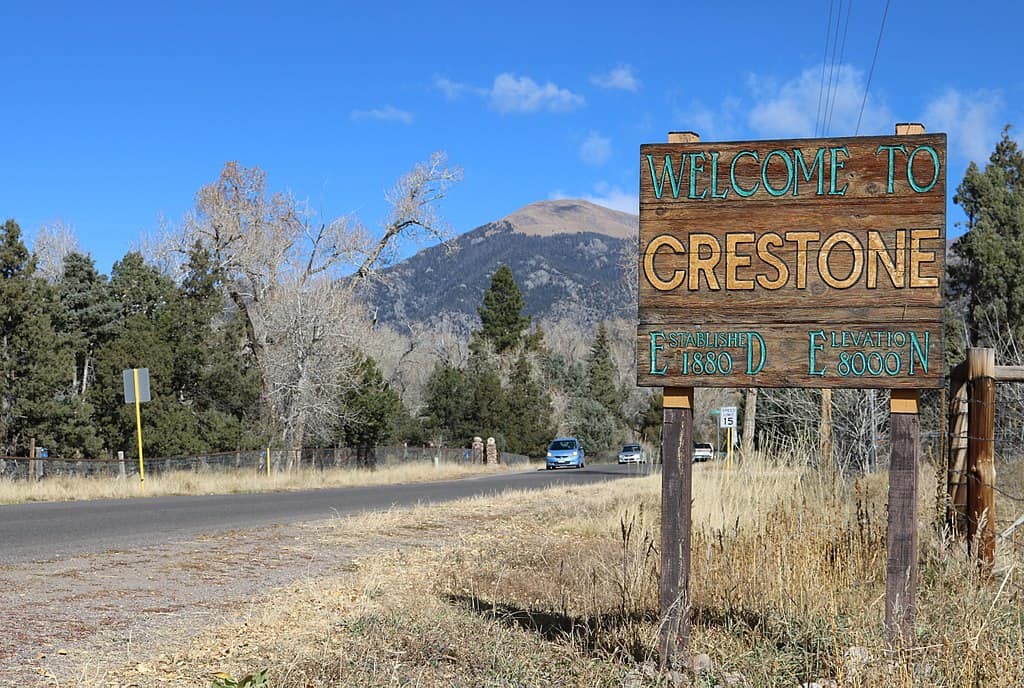
Crestone, Colorado: Where the Sangre de Cristos Meet the Mystics
Tucked against the sheer western face of the Sangre de Cristo Mountains, Crestone is the kind of place that feels like it exists just a little outside of ordinary reality. Fewer than 150 people live inside the official town limits, but the surrounding Baca Grande community swells that number to more than a thousand — a concentration of artists, astronomers, Buddhist monks, Carmelite nuns, Hindu priests, hermits, scientists, and outdoor obsessives unlike anywhere else in Colorado. Horses sometimes wander the dirt streets. The nearest stoplight is 30 miles away. And the peaks that rise straight up behind town include some of the most rugged fourteeners in the Lower 48.
Crestone sits at roughly 7,926 feet in the northeastern corner of the San Luis Valley, a vast high-altitude basin that stretches more than 120 miles from end to end. To the west, the valley unfurls flat and pale toward the San Juan Mountains. To the east, the Sangre de Cristo range erupts almost vertically from the valley floor, climbing more than 6,000 feet in just a few horizontal miles. It’s one of the most dramatic elevation gains in North America, and it gives Crestone its signature view — a wall of stone and snow that turns blood-red at sunset, which is how the Sangre de Cristos (“Blood of Christ”) got their name in the first place.
This is not a town you stumble upon. Crestone is a 45-minute detour off US Highway 17, down a county road that ends at the mountains. You have to want to come here. And the people who do — whether for a weekend or for the rest of their lives — tend to feel the pull of something hard to name. Maybe it’s the famously quiet nights under some of the darkest skies in the state. Maybe it’s the sense that the valley, ringed by 14,000-foot peaks on every side, is its own self-contained world. Whatever it is, Crestone rewards travelers who slow down enough to notice it.
| Quick Facts | |
|---|---|
| Elevation | 7,926 feet |
| Population | ~145 (town), ~1,400 (Baca Grande area) |
| County | Saguache County |
| Distance from Denver | 227 miles (about 4 hours) |
| Founded | 1880 (incorporated 1901) |
| Nearest 14ers | Crestone Peak, Crestone Needle, Kit Carson, Challenger Point, Humboldt Peak |

A Short History of Crestone
Long before miners or monks, the San Luis Valley was hunting and gathering territory for the Ute people, who considered the Sangre de Cristo range sacred and seasonal home. Spanish explorers passed through in the 1600s and 1700s, and Hispanic homesteaders moved north from New Mexico in the mid-1800s, establishing some of Colorado’s oldest continuously inhabited settlements along the valley’s southern edge.
The town of Crestone was born, like so many Colorado mountain towns, out of a rush. Gold and silver were discovered in the Sangre de Cristo range in the late 1870s, and by 1880 prospectors were swarming the foothills above the valley floor. Crestone was platted in 1880 and incorporated in 1901, and for a brief stretch it boomed alongside mines with names like the Independent, the Cleveland, and the Lucky. The ore never quite lived up to the promise, though, and by the 1920s most of the claims had played out. Crestone shrank to a quiet ranching and homesteading community, all but forgotten by the outside world.
Everything changed in the late 1970s. The vast Baca Grant — a Mexican land grant that covered much of the area — was being subdivided for development, and the Aspen Institute’s Maurice Strong acquired a huge tract. Strong and his wife Hanne began inviting spiritual teachers from around the world to establish retreat centers on donated land, creating what became known as the “Spiritual Valley.” Carmelite nuns, Tibetan Buddhists, Hindu devotees, Zen practitioners, and Japanese Shinto priests all built sanctuaries within a few miles of each other. By the early 2000s, Crestone had become internationally known as one of the most religiously diverse small communities on Earth — a place where the call to prayer from one tradition might drift across a field and mingle with the chanting of another.
The Spiritual Landscape of Crestone
More than two dozen spiritual centers operate in and around Crestone, and most of them welcome visitors who are respectful of their practices. This is what draws many travelers to the area — not necessarily to convert or enroll in anything, but simply to walk quietly through spaces that were built with genuine intention.
The Nada Carmelite Hermitage, tucked into a pine grove above the Baca, is the oldest of the centers, founded in 1983 by Spiritual Life Institute Carmelites seeking silence and solitude. Visitors can walk the outdoor stations of the cross, sit in the small adobe chapel, or arrange a guided retreat. A short drive away, the Yeshe Khorlo Tibetan Buddhist center and its gleaming white stupa are open to visitors during daylight hours, as is the Vajra Vidya Retreat Center, which houses one of the largest collections of sacred Tibetan texts outside of Asia.
The Haidakhandi Universal Ashram, run by devotees of the Indian saint Haidakhan Babaji, is famous for its Divine Mother Temple, where a fire ceremony (havan) is performed twice daily and visitors are welcome to attend. The Sri Aurobindo Learning Center hosts lectures and meditation retreats rooted in integral yoga. A small Shumei International Institute follows a Japanese tradition of natural agriculture and sacred music. And the Crestone Mountain Zen Center, perched high on the flanks of the Sangres, offers residential training for serious Zen students and limited day visits to the public.
A self-guided “Spiritual Sites Tour” map is available at the Crestone Visitor Information Center, and the town’s informal rule is simple: show up quietly, leave any donation you feel moved to, and treat every space the way you’d want your own sacred place treated.
Outdoor Recreation Around Crestone
For all its spiritual reputation, Crestone is first and foremost a mountain town, and the hiking, climbing, and backcountry access here are among the best in Colorado. The Sangre de Cristo range forms an almost continuous wall immediately east of town, and a network of trails leads into some of the wildest country in the state. Most of this land lies within the Sangre de Cristo Wilderness, which means no motors, no mountain bikes, and very few people.
Willow Creek Trail and Willow Lake
The most popular Crestone hike is the climb to Willow Lake, a jewel-blue alpine tarn tucked into a cirque at 11,564 feet directly beneath the east face of Kit Carson Peak. The trail leaves from the Willow Creek trailhead at the edge of the Baca Grande subdivision and climbs about 2,600 feet over 4.2 miles one way, passing through aspen groves, crossing talus fields, and finally breaking out above treeline into a hanging valley with a thundering waterfall at its head. Willow Lake is one of the best-known alpine lake hikes in southern Colorado, and in July and August the final approach is lined with Colorado columbine, Indian paintbrush, and elephant-head lousewort.
Climbing Crestone’s Fourteeners
Five of Colorado’s 58 fourteeners are clustered directly above Crestone: Crestone Peak (14,299 feet), Crestone Needle (14,203 feet), Kit Carson Peak (14,171 feet), Challenger Point (14,087 feet), and Humboldt Peak (14,070 feet). Of these, Humboldt is the easiest — a long but non-technical Class 2 walk-up from South Colony Lakes. The others are serious mountaineering objectives. Crestone Needle’s standard route is considered one of the most committing Class 3 climbs on any fourteener, with exposed ledges and loose rock, and Crestone Peak is comparable. Kit Carson and Challenger Point are often climbed together from the Willow Lake approach on the Crestone side, which turns the day into a 16-mile round trip with 6,000 feet of elevation gain. None of these peaks should be taken lightly, and experienced climbers are the rule, not the exception, at the trailheads.
North Crestone Creek Trail
For travelers looking for a gentler experience, the North Crestone Creek Trail starts right at the North Crestone Campground just north of town and follows a tumbling creek up through cottonwoods and conifers. The first two miles are mellow and family-friendly; beyond that, the trail climbs steadily toward North Crestone Lake, another alpine lake hidden beneath 14,000-foot peaks. This is the quietest of the major Crestone drainages, and it’s a good choice for wildflower walks, fly fishing, and early-season warm-ups.
South Colony Lakes
On the east side of the range, accessed from the town of Westcliffe, the South Colony Lakes basin is the traditional launching point for climbing Crestone Peak, Crestone Needle, and Humboldt. The high-clearance 4WD road to the upper trailhead was closed to motorized use years ago, which means most climbers now backpack in and camp at the lakes. The basin itself is spectacular — a chain of glacial lakes set directly beneath some of Colorado’s most iconic skyline.
Cottonwood Lake and Other Dayhikes
Other worthwhile hikes from the Crestone side include the trail to Cottonwood Lake (a long but moderate day to another stunning alpine basin), the short loop through the Crestone Needle Vista at the west end of town, and the network of dirt roads and trails that crisscross the Baca Grande, which are popular with trail runners and dog walkers looking for an early-morning mountain view.

Dark Skies and the Baca National Wildlife Refuge
Because Crestone sits in one of the least light-polluted corners of Colorado, the night sky here is almost theatrically dark. The Milky Way stretches from horizon to horizon on a clear August night, and you can routinely see the Andromeda Galaxy with the naked eye. Several of the spiritual centers host informal stargazing programs, and on moonless nights you can simply drive a few miles out into the Baca National Wildlife Refuge and pull over. The refuge — more than 92,000 acres of shortgrass prairie, wetlands, and cottonwood bosque — borders Crestone on the south and west and hosts elk, mule deer, pronghorn, coyotes, and a remarkable variety of birds. Sandhill cranes stop here by the thousands during their spring and fall migrations, and the refuge is an extension of the internationally recognized crane viewing around Monte Vista.
The Crestone Music Festival
The first full weekend of August, Crestone hosts its signature annual event: the Crestone Music Festival, or “CrestFest” as locals call it. For three days, the normally quiet town fills up with musicians, food trucks, craft vendors, and a remarkably diverse crowd of dreadlocked hippies, silver-haired monks, valley ranchers, and Denver weekenders. The lineup leans toward Americana, folk, bluegrass, world music, and jam bands, and the setting — an open meadow with the 14,000-foot wall of the Sangres as a backdrop — is hard to beat. CrestFest is family-friendly, relatively affordable, and consistently ranked among the best small music festivals in the Rockies. Tickets typically sell out in advance, so plan ahead if you’re aiming to visit during festival weekend.
Food and Drink in Crestone
Crestone’s food scene is small — this is a town of fewer than 150 residents, after all — but the quality is surprisingly good and the vibe is quintessentially local. Expect to find vegetarian and vegan options on almost every menu, organic ingredients wherever possible, and conversation with the owner as a standard part of the meal.
The Cloud Station, located in the old general store building on Galena Avenue, is the closest thing Crestone has to a community gathering spot. It serves coffee, baked goods, breakfast burritos, and a rotating lunch menu, and the back patio looks directly up at the Sangres. The Desert Sage is another local favorite, known for wood-fired pizza, fresh salads, and a solid beer selection. For groceries and supplies, the Crestone Mercantile carries a surprising variety for its size, including local produce, bulk grains, and organic staples.
Down in the Baca Grande, the Shambhala Restaurant and a handful of seasonal food trucks round out the options. If you’re driving in from the north or east, plan to stock up in Salida or Westcliffe — there’s no chain grocery, no fast food, and no big-box store anywhere in the San Luis Valley’s northern reaches, and that’s exactly how Crestone likes it.
Arts, Culture, and Community Events
Crestone punches far above its population weight for cultural programming. The Crestone Artisans Gallery showcases work by dozens of local painters, potters, jewelers, photographers, and fiber artists, and the gallery’s monthly openings are as much social events as art shows. The Crestone Performances concert series brings touring classical, jazz, and world-music acts into town most months of the year — often in unlikely venues like the Crestone Charter School auditorium or one of the retreat center sanctuaries.
The annual Crestone Solstice gatherings — one in June, one in December — are community celebrations that mix music, ceremony, and potluck in a way that feels unmistakably Crestone. Sacred fire ceremonies, sometimes open to respectful visitors, happen at various centers throughout the year. And the local Crestone Eagle newspaper, one of the smallest independent monthlies in Colorado, is an indispensable guide to whatever is happening the week you’re in town.
Where to Stay in Crestone
Lodging in Crestone is mostly small, independent, and full of character. You won’t find a Hampton Inn here — and that’s the point. The Crestone Inn, right on the edge of town, offers simple motel-style rooms, a small restaurant, and an unbeatable view of the Sangres from the front porch. The Sanctuary House, on a wooded lot at the base of the mountains, functions partly as a B&B and partly as a small retreat center, with private rooms and shared meditation space.
A number of the spiritual centers themselves offer overnight stays as part of structured or self-guided retreats — the Nada Hermitage, the Haidakhandi Ashram, and the Crestone Mountain Zen Center all have guest accommodations ranging from austere to surprisingly comfortable. These are not traditional hotels; they’re working religious communities, and staying in one means participating to some degree in the rhythm of the place. For travelers who want quiet lodging without the spiritual framework, vacation rentals in the Baca Grande are the most common option, with dozens of cabins, casitas, and small homes available through the usual booking platforms.
Camping is abundant in the surrounding area. The North Crestone Campground, a small Forest Service site just north of town, has about a dozen sites on a first-come, first-served basis and is the most convenient place to car camp. Dispersed camping is allowed on most of the surrounding national forest land, and for climbers, backpacking into the Willow Creek or South Colony basins is the standard approach to the fourteeners.
Day Trips from Crestone
Great Sand Dunes National Park (35 miles)
The closest and most essential day trip from Crestone is the Great Sand Dunes National Park & Preserve, about 35 miles south along County Road T and Highway 150. The tallest dunes in North America rise more than 750 feet above the valley floor, and the contrast between the golden sand and the Sangre de Cristo peaks behind them is one of the most photographed landscapes in the American West. In spring, the seasonal Medano Creek runs at the base of the dunes and creates a wide, shallow beach where kids splash and sand sledders cool off. The park is free to walk on, easy to visit in half a day, and absolutely unforgettable.
Salida (60 miles)
The closest real town with a full range of restaurants, breweries, and shopping is Salida, about 60 miles north over Poncha Pass. Salida’s historic downtown hugs the Arkansas River and is full of galleries, bike shops, cafes, and whitewater play features. It makes an easy day trip for travelers who want a change of pace or need to pick up anything Crestone can’t provide.
San Luis and the Stations of the Cross (55 miles)
San Luis, Colorado’s oldest continuously inhabited town, sits in the southern end of the valley about 55 miles from Crestone. Its famous Stations of the Cross shrine climbs a mesa above town with life-sized bronze sculptures by sculptor Huberto Maestas, and the summit views stretch across the entire San Luis Valley. It’s a powerful complement to Crestone’s own spiritual landscape and a good window into the Hispanic Catholic roots of the region.
Westcliffe and the Wet Mountain Valley (75 miles by road)
On the east side of the Sangre de Cristo range — as the crow flies, just 15 miles from Crestone, but 75 miles by road around the north end of the mountains — the small ranching town of Westcliffe is an International Dark Sky Community and a launching point for climbing the east-side routes on the Crestone fourteeners. The drive around via Salida is scenic in its own right, and Westcliffe’s downtown is worth an afternoon.
Planning Your Visit to Crestone
Getting there: Crestone is about a four-hour drive from Denver. The most common route is I-25 south to Walsenburg, then US 160 west over La Veta Pass to Fort Garland, then north on Highway 17 and east on County Road T to Crestone. An alternative is to take US 285 south from Denver, over Poncha Pass into the San Luis Valley, and south on Highway 17. Both routes are scenic. The closest commercial airports are Colorado Springs (about 150 miles) and Albuquerque (about 230 miles).
Getting around: You need a car in Crestone. There is no public transportation, no taxi service, and no ride-share. The town itself is walkable, but trailheads and spiritual centers are spread over several miles of dirt roads, many of which require moderate ground clearance.
When to go: Summer (June through September) is peak season for hiking, climbing, and festivals. July and August have the most reliable trail conditions, though afternoon thunderstorms are the daily rule above treeline. September brings golden aspens and quieter trails. Winter is cold and quiet; most hiking trails are buried in snow, but the Baca Grande roads stay plowed and the spiritual centers remain active. Spring is windy and muddy, with the payoff of sandhill crane migrations in the nearby refuges.
What to bring: Layers for rapid weather changes, sunscreen and hats for the intense high-altitude sun, plenty of drinking water, and cash or a checkbook for the smaller businesses (card readers sometimes struggle with the spotty cell service). Bring a good map — AllTrails works if you download offline — and let someone know your plans if you’re heading into the Sangres.
For official planning information, the Town of Crestone’s official website has municipal updates and event listings. The Rio Grande National Forest manages the public lands and trails above town. The Great Sand Dunes National Park website covers the most popular day trip. And Colorado Parks & Wildlife has fishing licenses, wildlife closures, and the up-to-date rules for the state-managed lands nearby.
Related Articles
- Alamosa, Colorado: Great Sand Dunes, 3 Fourteeners & the Heart of the San Luis Valley
- Salida, Colorado
- Buena Vista, Colorado
- Pagosa Springs, Colorado
- Manitou Springs, Colorado
